

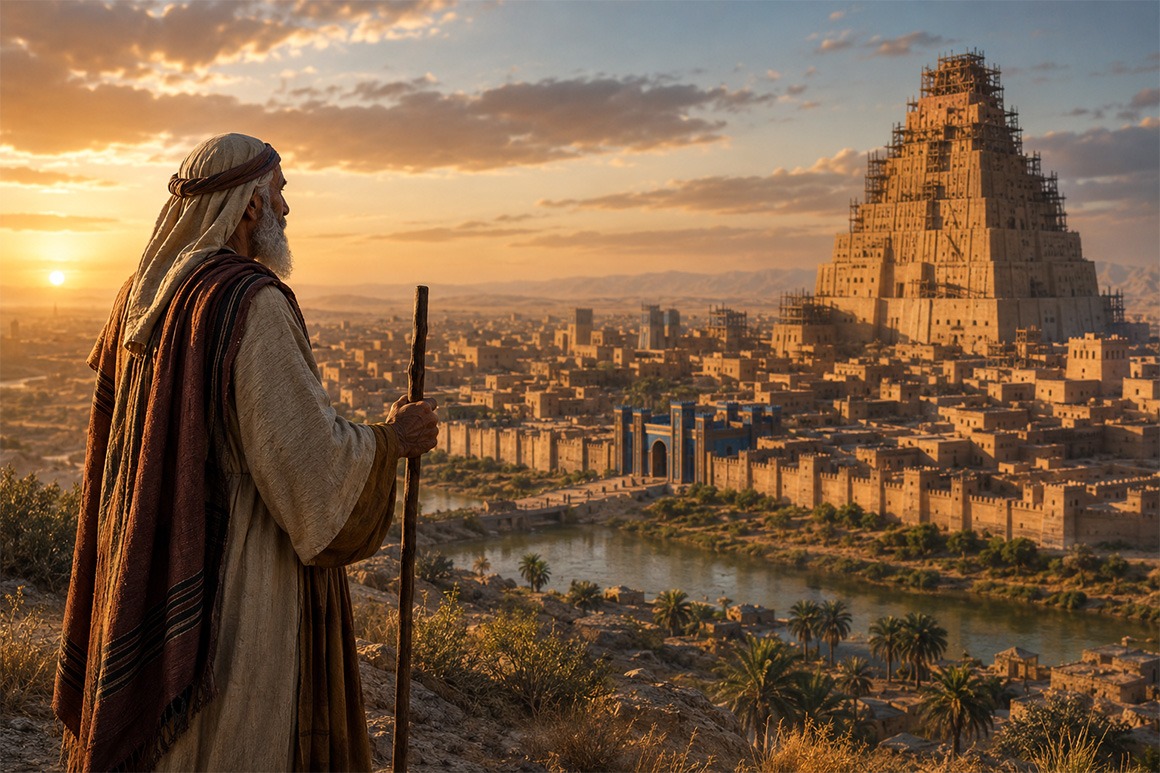
How God called Abraham out of the most powerful civilization of his time—and why that call continues to resonate to this day. By Stephan Kobes
Reading time: 14 minutes
Why did Abraham voluntarily leave one of the most advanced civilizations of his time? While others sought security, prosperity, and a future in the burgeoning cities of Mesopotamia, he heeded a quiet voice: “Go!” What began with this departure became a decision that changed world history.
Since time immemorial, people have sought security in powerful empires. They are drawn to places where the economy is strong—where security, prosperity, and social advancement are promised.
But one man did the opposite.
The future seemed to lie in the great cities of Mesopotamia. Here beat the heart of one of the most advanced cultures of the world at that time. Here, for many, every dream seemed within reach.
But it is precisely there that God says:
“Go away.”
A Call Against the Tide
He called on a man to leave behind everything on which others built their future: his homeland, his relatives, his security, his plans.
And He said:
“Leave your native land, your relatives, and your father’s house, and go to the land that I will show you.” (Genesis 12:1)
His name was Abraham. He saw no map. He received no itinerary. He was given only a promise. And that was enough. He considered it more reliable than anything his homeland could offer him. And his departure changed the world.
Three major world religions call him their father. For billions of people, he is a role model of faith.
At the center of the world at that time
When we think of Abraham, we often imagine a nomad—a man with sheep, tents, and camels, wandering through remote regions. But that’s not how his story begins.
It begins in one of the most advanced regions of the world at that time. But why would a man voluntarily leave the world that others dreamed of?
The World of Nimrod—When Power Builds Cities
What do we know about the time when God called Abraham out of his homeland?
He lived in an extraordinary era. Memories of the Flood had not yet completely faded. The earth was once again filling with people. Cities sprang up, trade routes were opened, and ambitious rulers began to expand their power.
The Bible mentions a name that stands out above the early centuries following the Flood: Nimrod.
Of him it is said: “He was the first to wield power on earth” (Genesis 10:8)
He was a mighty conqueror.
“The beginning of his kingdom was Babel, Erech, Akkad, and Calneh in the land of Shinar.” (Genesis 10:10)
These are the names of the first great cities in the Bible. Here, centers of power and culture arose. Here, trade routes were controlled, temples were built, and administrative systems were established. Here, people, wealth, and influence gathered.
The Dawn of a New Civilization
The world was on the cusp of a new era. From the plains of Mesopotamia, a new civilization was rising. Larger. Stronger. More impressive than anything people had seen since the Flood.
That is exactly where the story of Abraham begins. In the midst of a world of new beginnings, ambition, and human self-confidence.
The great cities of Shinar were not legends of a bygone era, but the defining centers of its present. Erek—one of Nimrod’s cities—lay not far from Abraham’s hometown of Ur.
But the Bible sees something else behind these cities.
A spirit. An idea. A dream.
A kingdom begins in the heart
Nimrod was “a mighty hunter before the LORD.” (Genesis 10:8–9)
He was an extraordinarily powerful man. A founder of an empire. A man who pursued power, influence, and human greatness. He promised people security. Unity. Strength. A future they could control themselves.
He revealed himself as a man whose gaze always soared higher—ultimately to heaven itself. And one question loomed ever larger:
Who should be at the center—God or man?
The Dream of Babel
At the heart of this burgeoning world, a structure soon arose that embodied the spirit of the age. The people decided to build a city and a tower “whose top reaches to the heavens” (Genesis 11:4).
Bricks were fired. Walls rose. The tower soared higher and higher above the plain. What was taking shape here was more than just a building. It was the symbol of a new humanity—united, organized, and full of confidence in its own strength.
But then the Bible reveals the true goal of the project:
“Let us make a name for ourselves.” (Genesis 11:4)
That was the true foundation of Babel. Not mud bricks. Not asphalt. Not walls. But human pride.
The question was no longer, “What does God want?” but rather, “What can we achieve?”
The Quiet Voice of God
Abraham didn’t have to imagine Babel. He could see its influence. He could hear its promises. He could feel its pull. The world around Abraham was loud. People spoke of power, trade, and the future.
But amid the noise of his time, Abraham heard another voice. A soft voice. God’s voice.
How?
The Bible doesn’t tell us. Perhaps God spoke to him directly. Yet Abraham’s world was not without light. In his day, the warning voices had not yet fallen silent. The memory of the Flood was still alive.
Witnesses to a Past World
Noah’s testimony was still fresh in people’s minds. When Abraham left Ur, Noah’s death had occurred only a few years earlier (see Genesis 11). Shem was also still alive—a man who had known the world before the Flood and had entered the ark. The Flood was not merely a chapter in history. It was family history. Grandfathers told their grandchildren about God’s judgment. The memory of a destroyed world had not yet faded.
Even in that era of emerging new kingdoms, God’s light had not gone out. Abraham’s encounter with Melchizedek, the priest of the Most High God, was also a quiet testimony to this. Even in that generation, God had men who knew Him and passed on His truth.
Amid the clamor of burgeoning civilizations, the voice of heaven could still be heard. And Abraham listened.
Nimrod followed the dream of a civilization.
Abraham followed the voice of God.
And to this day, these two voices contend for the heart of man.
One says:
“Make a name for yourself.”
The other says:
“Follow me.”
Abraham and Nimrod—Two Ways to Make History
If Abraham had listened to the voices of his time, they would have advised him: Stay in Ur. It has everything! Infrastructure. Trade. Education. A future.
But God said, “Go.”
And Abraham went.
Therein lies his true greatness. Abraham did not leave behind poverty, chaos, and backwardness. He left behind success, security, culture, influence, and plans for the future.
But who made history? The man with the cities? Or the man with the tent?
Was the voice right?
History has long since rendered its verdict. Today, Nimrod’s cities lie in ruins. Where Babylon once formed the heart of the ancient world, desert winds now sweep across fields of ruins where archaeologists dig for clues to past greatness. The cities fell silent. But the voice that Abraham followed has not fallen silent.
The name Abraham also lives on. His influence endures to this day. Because he left when others stayed. Because he listened when others were amassing wealth and power. Because the voice of God was more precious to him than the treasures of this world.
God’s Judgment on the Kingdoms
However, the Bible does not view the downfall of these kingdoms solely as a consequence of political developments. It points to a deeper cause.
“Why has the land perished and been scorched like a desert through which no one passes?” (Jeremiah 9:11)
God Himself provides the answer:
“Because they have forsaken my law, which I set before them.” (Jeremiah 9:12–13)
God took Abraham out of a culture where people sought to make a name for themselves, in order to write a story with him in which God’s name would be exalted.
But even the idea of Babel outlived its first empire-builder. The first hunter had appeared—and others would follow in his footsteps.
Nimrod’s Heirs—The Hunters of History
Centuries passed. Empires rose. Empires fell. Yet time and again the same spirit appeared—the spirit of a tyrant.
For centuries later, Daniel sees the world empires. Not as shepherds. Not as sheep. But as predators. Daniel saw a lion. Then a bear. Then a leopard. And finally, a terrifying beast, stronger than all the others before it. (See Daniel 7:2–7)
They hunt. They devour. They rule. They subdue the world. But was that the dominion God had entrusted to humankind in the beginning? Did God give humankind a crown—or fangs?
The first tyrant in the Bible appears as a hunter. And his successors embody the same spirit.
Predators of World History
Babylon rose like a lion. It adorned itself with the mighty walls and magnificent palaces of Nebuchadnezzar. Its armies subjugated nations.
Then came the bear. The Persians extended their power in all directions. They held fast to whatever they had seized with their paws. Their prey stretched from India to Egypt.
Then the leopard pounced. Alexander the Great swept across the earth with incredible speed. City after city fell. Empire after empire fell prey.
And finally, Rome appeared. Emperors had themselves revered as masters of the world. Their legions marched across three continents. They crushed and trampled whatever stood in their way.
The Kingdom of the Lamb
For millennia, hunters wrote history. Power-hungry kings had secured their thrones by force. They had sent out armies, destroyed cities, and celebrated triumphal processions. Time and again, the same spirit revealed itself: the hunt for power, for glory, for dominion. For a name.
But God reveals a different kingdom. When heaven sent its King, no general appeared on a warhorse. No conqueror. John saw “a Lamb that looked as though it had been slain” (Revelation 5:6).
A Different Language
The kingdoms of this world speak the language of the hunter: fangs. Claws. Powerful paws. Threats. Blasphemies. Violence.
But God Himself lets the language of the Lamb speak for Him. Not violence. But love. Not coercion. But invitation. Not domination, but service.
Two voices. Two paths. Two kingdoms.
And at the end of the story, every person stands where Abraham once stood. Between two voices. Between two paths. Between the hunter and the Lamb.
The Final Call from Babel
And right there, at the end of the story, the same voice that Abraham once heard rings out once more:
“Come out of her, my people, so that you may not share in her sins and so that you may not receive any of her plagues!” (Rev. 18:4)
At the end of the story, the Bible warns of a power that combines the characteristics of all the great world empires—“like a leopard, and its feet were like those of a bear, and its mouth was like the mouth of a lion.” (Revelation 13:2). The spirit of the hunter pervades history to this day. That is why God calls His people out once again—just as He did in Chaldea.
What had once brought Babylon to its downfall? Separation from God’s character. From God’s law. From God’s way of thinking. The desire to be great. The urge to dominate others. The spirit of tyranny.
And that is precisely why, at the end of history, God calls out once more:
“Come out of her, my people!”
This is more than a rejection of false teachings. It is about an attitude of the heart. A decision. A matter of character: Do I want to take or to give? To rule or to serve? To become great or to obey?
It means: not wanting to rule over others as a tyrant. To leave behind the spirit of Babel—the desire for human greatness, self-sufficiency, pride, and dominion over others.
The Decision of the Heart
Jesus therefore says:
“The rulers of the nations and the great ones of the world oppress their people and make them feel their power. But it must not be so among you. On the contrary: whoever among you wants to become great must be your servant.” (Matthew 20:25–26)
The Way Out of Babel
The curse of tyranny has wound its way through history ever since Nimrod. Through nations. Through peoples. Through families. Through communities. Through the human heart. Time and again, humanity has tried to establish greatness in the spirit of tyranny. And time and again, ruins were left behind—on battlefields, in homes, and in hearts.
But Jesus came to break this very curse: “I have set you an example.” (John 13:15)
He is the Lamb of God who takes away the sin of the world. And he showed that, in the end, only one way of life truly endures: not the way of the hunter, but the way of the Lamb.
Children of Abraham?
That is why the real question is: Are we children of Abraham?
Abraham did not merely leave Chaldea. He left behind Nimrod’s dream. And God continues to call people out to this very day.
Babel is not growing only in the capitals of this world. It grows wherever power becomes more important than love, success more important than faithfulness, and one’s own name is to be made greater than God’s name. It needs no mighty city walls. It is built when people exalt themselves by belittling others. When people use others instead of loving them, and rule instead of serving. When they turn others into tools for their own goals. Sometimes we build Babel right in the quietest thoughts of our own hearts.
The greatest danger at the end of the story is not that we recognize Babel. But that we learn to think like Babel.
Perhaps heaven is whispering to you, too.
Not: “Make a name for yourself.” Not: “Become stronger.” Not: “Rule.”
But: “Leave Babel.” “Follow me.” “And go to the land that I will show you.”
Abraham went. And the world was never the same again.
Heaven is still whispering today. The question is: Will we go, too?
Leave a Reply