

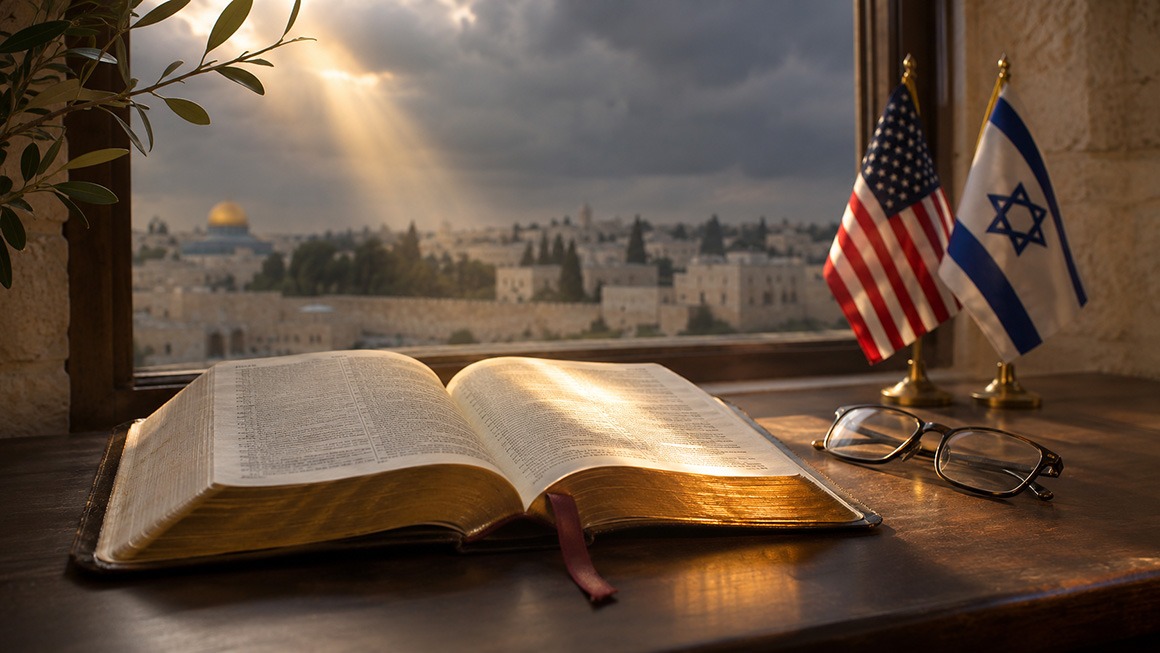
Political developments in the U.S. raise questions about Israel’s future and its role in the world. A Zionist reader’s letter in the Jerusalem Post led me to an ancient prophecy. Upon rereading Ezekiel 38 and 39, I discovered a message that, like a ray of light, provides guidance even where differing perspectives limit our view of God’s message. By Kai Mester
Reading time: 7 minutes
A reader of the Jerusalem Post who identifies as a Zionist wrote today, after the outcome of the U.S. election became clear:
“Now Israel stands alone; that is the reality. This brings to mind Ezekiel 38, where Israel has only one ally left: God. And that is enough.”
Let’s try for a moment to put ourselves in his Jewish perspective, which is foreign—or at least unfamiliar—to many Christians and Adventists:
In fact, a new geopolitical constellation is emerging: Democrats hold clear majorities in the Senate and the House of Representatives. With El-Sayed, the first Muslim senator in U.S. history will take office. For many Israelis, this comes as a shock. The Democrats—and El-Sayed in particular—have repeatedly championed Palestinian rights and sharply criticized the Middle East policies of Netanyahu and Trump.
For Israel, this could mark the beginning of a period in which support from Washington becomes significantly more uncertain. And Washington is considered one of its last loyal allies. Hence the growing sense of “being alone.” Could this present an opportunity for many Jews to turn more strongly toward God? And thereby also recognize their true Messiah?
But first, the question: What does Ezekiel 38 and 39 actually say?
A storm is gathering against God’s people
The prophet Ezekiel describes a mighty army made up of numerous peoples and nations that descends upon the “people of Israel” (verses 14–16) and the “land of Israel” (verses 18–19). Like a violent storm. Israel stands alone. No one comes to its aid.
But then the unexpected happens: God Himself intervenes.
He unleashes natural disasters, confusion, and panic among the attackers. The mighty army spirals out of control and eventually even turns on itself.
The message behind this is unmistakable: When all human certainties crumble, God remains. And it is precisely through this that the whole world is to recognize that the God of “Israel” is the true God.
Who is Israel?
Naturally, many sincere Jews will relate these chapters to the fate of the nation-state founded in 1948. For some, “Israel” is the country itself or its government. For others, it is its Jewish population. Still other Jews—some of whom even reject the State of Israel—may understand it to mean the Jewish people in general, quite independent of any nation-state. Yet the feeling can grip everyone: The tide is turning against us. International sentiment is shifting. Jews and Israelis are once again being perceived as a threat and a problem.
But anyone who reads Ezekiel’s message through this lens discovers more than a promise of divine salvation. They also encounter an uncomfortable question: What if not only the enemies, but also “Israel” itself is called to repentance?
And therein I see the true light of this prophecy. For it shines through every interpretation and thus also reaches perspectives and people who do not yet know or understand the Good News of Jesus and the Adventist prophecies of Daniel and Revelation.
However, many non-Jews also identify with “Israel,” the new name for Jacob—people who, just like Jacob, wrestle with God and refuse to let Him go. They, too, make these promises their own.
And then there are those who share Jacob’s experience without being able to put a name to it all.
When God Hides His Face
“And the house of Israel shall know that I, the LORD, am their God, from that day forward and onward. And the nations shall know that the house of Israel was carried away because of its iniquity. Because they had sinned against me, I hid my face from them and delivered them into the hands of their enemies, so that they all fell by the sword. I dealt with them according to what they deserved for their uncleanness and their transgressions, and I hid my face from them.“ (Ezekiel 39:22–24)
These verses give us pause for thought. No person, no family, no nation is above God’s standards. Even “Israel” is not exempt from responsibility and accountability. Being chosen never means a free pass for wrongdoing.
The combination of external distress and an inner recognition of sin once led the listeners of John the Baptist to repentance and prepared them for the Messiah. Could more difficult times for Israel also trigger such reflection in some people—and lead them to recognize their guilt and turn to Jesus?
The Hope of a New Beginning
Ezekiel’s prophecy culminates in a mighty promise:
“Then they will know that I, the LORD, am their God, who led them away among the nations and am gathering them back to their own land, leaving not one of them behind. And I will no longer hide my face from them, for I have poured out my Spirit upon the house of Israel, says the Lord God.” (Ezekiel 39:28–29)
What a turnaround! God’s hidden face becomes His presence. Dispersion gives way to gathering. Out of guilt springs hope for a new beginning.
Jesus is the One who turns swords into plowshares. At the same time, His words of love become a spiritual sword: They pierce through our old, self-centered nature and call us to a new life of love for our enemies. I hope that more and more Jews will recognize and experience this.
There are Messianic and Adventist Jews in Israel. Yet even in these circles, the fire of love for one’s enemies has not yet gripped everyone. This, however, is a problem we as Christians and Adventists are equally familiar with. We, too, must therefore continually ask ourselves: To what extent do we actually allow ourselves to be shaped by Jesus’ love for one’s enemies?
What does Ezekiel 38 and 39 have to do with me?
What does the message from Ezekiel have to say to other nations—and thus also to most of us who are reading this article?
More than we might initially think. Aside from its eschatological and global fulfillment in the coming Sabbath-Sunday crisis, it also contains a pastoral principle that can be applied on many levels.
You and I, too, can find ourselves in situations where we feel abandoned by everyone. People we’ve relied on turn their backs on us. Our sense of security crumbles. Suddenly, we’re left alone facing a situation we can no longer handle on our own.
It is precisely then that a new perspective can open up: When we turn to God and make Him our firm anchor, His Spirit can also fill our lives. Our past no longer has to hold us captive. Guilt, failure, and wrong turns do not have to have the last word.
Ezekiel 38 and 39 are therefore both a warning and a promise for all the spiritual children of Abraham.
For it is not only individuals but also religious communities that can lose themselves in self-righteousness. They can become so convinced of their own election and their own truth that they forget what truly matters to God. And sometimes it is precisely those who speak His name who cast dark shadows upon Him.
Yet there is hope. Whenever people are willing to admit their guilt and repent, a path back to God opens up.
One of the most beautiful images: blood becomes snow, crimson becomes wool
The prophet Isaiah expresses this hope in one of the most beautiful images in the Bible:
“Though your sins are like scarlet, they shall be as white as snow; though they are red as crimson, they shall be as white as wool.” (Isaiah 1:18)
This is the most important message of these prophecies: God does everything He can to ensure that people are not left in their guilt. He can transform what, from a human perspective, seems irretrievably lost.
Often, this path begins precisely where all other certainties fail.
Leave a Reply