

How Did the Advent Movement Begin? Can We Explain Its History and Mission from the Bible? And Can We Find the Advent Movement in Scripture, Especially in Prophecy?
Sermon recording by Waldemar Laufersweiler
PODCAST
AI-generated voice (ElevenLabs)
These questions take us to the foundations of our faith. Our purpose is not to discover something entirely new. Rather, it is good to refresh what we already know and think it through again. We want to understand why we are Seventh-day Adventists, what our faith rests on, and what that means for our lives.
A single sermon cannot address every detail of biblical prophecy. But we can follow its central thread. To do so, we will look at three passages: Revelation 12, Revelation 10 and 11, and Malachi 3.
Revelation 12: The Woman as a Symbol of God’s People
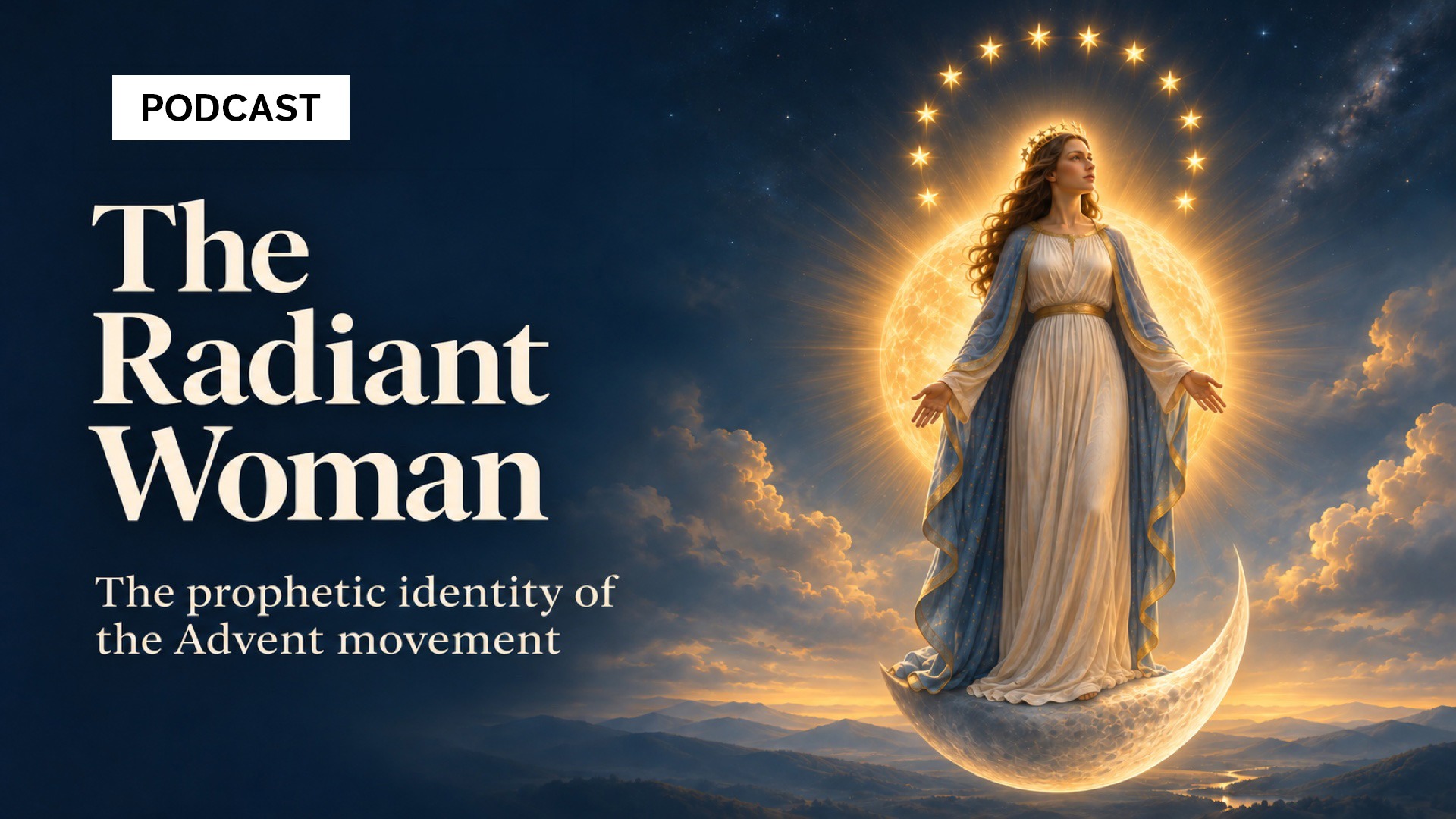
At the beginning of Revelation 12, John sees a great sign in heaven: a woman clothed with the sun. The moon is beneath her feet, and on her head she wears a crown of twelve stars. She is pregnant and cries out in the pain of approaching childbirth.
In this interpretation, the woman represents God’s people, His church. We encounter this imagery elsewhere in the Bible as well, for example in Isaiah 54:5–6.
The crown on her head speaks of dignity and victory. Kings wear crowns, and winners in athletic contests received a victor’s wreath. Those called by God can hold their heads high. Their dignity rests on belonging to Him.
The twelve stars point to the twelve tribes of Israel in the Old Testament and the twelve apostles in the New Testament. They connect the history of God’s Old Testament people with the Christian church, which was built up through the ministry of the apostles.

The Sun and the Moon: God’s Light and the Prophetic Word
The woman is clothed with the sun. The sun symbolizes God’s light, His truth, and the righteousness of Christ.
The moon beneath her feet, however, deserves particular consideration. The moon has no light of its own. It reflects the light of the sun and helps us find our way in the darkness.
We find a similar image in 2 Peter 1:19. There, the prophetic word is compared to a light shining in a dark place. It gives us guidance while darkness surrounds us.
The moon can therefore be understood as pointing to the prophetic word. Throughout history, God’s people have been sustained by His promises and His prophetic word.
This is also true of the Advent movement. It arose through the study of prophecy. Figuratively speaking, it owes its beginnings to the light of the moon. We are a prophetic movement, and we still stand on that foundation today.
The Dragon and the Child: The Great Controversy
In Revelation 12:3–4, another sign appears: a great, fiery red dragon with seven heads, ten horns, and seven royal crowns. His tail sweeps away a third of the stars of heaven and throws them to the earth.
The dragon stands before the woman who is about to give birth, intending to devour her child as soon as it is born.
Later in the chapter, the dragon’s identity is explicitly explained: he is the ancient serpent, the devil and Satan, who deceives the whole world.
The woman here must not be understood as representing Mary alone. She represents God’s people awaiting their promised Messiah. The child she gives birth to is Jesus Christ. Verse 5 says that He will rule all nations with an iron rod and that He is caught up to God and His throne.
The chapter thus takes us into the very heart of the great controversy in which God’s people have always been involved.
Jesus Christ Is the Victor
Revelation 12:7–10 describes the war in heaven. Michael and His angels fight against the dragon and his angels. The dragon does not prevail. No place is found for him and his angels in heaven any longer; they are thrown down to the earth.
A loud voice in heaven then announces the salvation, power, and kingdom of God, and the authority of His Christ. The accuser of the believers, who accused them before God day and night, has been thrown down.
The central message is this: Jesus is the victor. Through Him, the outcome of the great cosmic conflict has already been decided.
For the earth, however, the conflict continues. While heaven is called to rejoice, a warning is pronounced over the earth and the sea: the devil has come down to them in great anger because he knows that he has only a little time left.
In the midst of this description, we find a promise we want to hold on to:
“And they overcame him because of the blood of the Lamb and because of the word of their testimony, and they did not love their lives even unto death.” Revelation 12:11
We will return to this at the end. For our concern is not merely to understand how the prophecies fit together. It is to overcome through the blood of Jesus ourselves.
The Woman in the Wilderness: Persecution and God’s Protection
After the child has been caught up to God, the woman flees into the wilderness. There, God has prepared a place for her where she is nourished for 1,260 days.
Later, the chapter describes the same situation through another image: the woman is given the two wings of a great eagle so that she can fly to her place in the wilderness. There she is nourished for “a time, times, and half a time.”
The wilderness represents a difficult experience. It suggests desolation, drought, and deprivation. God’s church experiences persecution and must flee. This is a time of hardship for her. Yet she has not been abandoned: God has prepared a place for her and provides for her.
The dragon continues to pursue the woman. From his mouth, he sends water rushing after her like a river, intending to sweep her away.
In prophetic imagery, water is understood as a symbol of peoples and multitudes. Here we see a picture of persecution in which people are stirred up against God’s church in order to destroy it.
But Revelation 12:16 tells of help:
“And the earth helped the woman, and the earth opened its mouth and swallowed the river that the dragon had poured out of his mouth.”
This does not necessarily mean that persecution immediately ceased everywhere. But those being persecuted receive a place of refuge where they can escape the immediate reach of their persecutors.
This image points to North America. Many persecuted Christians found refuge there. Not all of Christendom moved there, but for many, North America became an important place of freedom and a starting point for further developments.
With this thought in mind, we read the next verse.
The Remnant: God’s Commandments and the Testimony of Jesus
Revelation 12:17 describes how the dragon becomes enraged with the woman and goes to make war against the remnant of her offspring.
The woman has offspring: earlier generations are followed by further generations of believers. Yet the text draws our attention particularly to the remnant of her offspring. They are the target of the dragon’s attack.
It is striking that the focus here is not on all her offspring indiscriminately. Our attention is drawn to a smaller group within the generations that follow. Others, too, continue to regard themselves as part of God’s church. But the remnant are described by two distinctive characteristics:
They keep the commandments of God and have the testimony of Jesus.
These two identifying marks belong together. These are people who hold to all of God’s commandments and also possess the testimony of Jesus.
 What Does the Testimony of Jesus Mean?
 What Does the Testimony of Jesus Mean?
Revelation 19:10 explains:
“The testimony of Jesus is the spirit of prophecy.”
The spirit of prophecy is a gift from God. Through it, there is a direct connection between heaven and earth: God reveals Himself to a person, and that person passes on the message received.
This may involve one person or several people. Joel 2:28–29 describes God pouring out His Spirit: sons and daughters prophesy, old people dream dreams, and young people see visions. God can address people of different generations and speak through them.
If we take these characteristics seriously, we may sincerely ask: Where do we find people who hold to all of God’s commandments and among whom this prophetic gift is also evident?
From an Adventist perspective, this question leads us to our own origins and mission. But Revelation 12 is not the only passage in which we can recognize indications of the Advent movement.
Revelation 10: The Open Book and the Advent Movement
In Revelation 10, John encounters an angel holding a little book that is open.
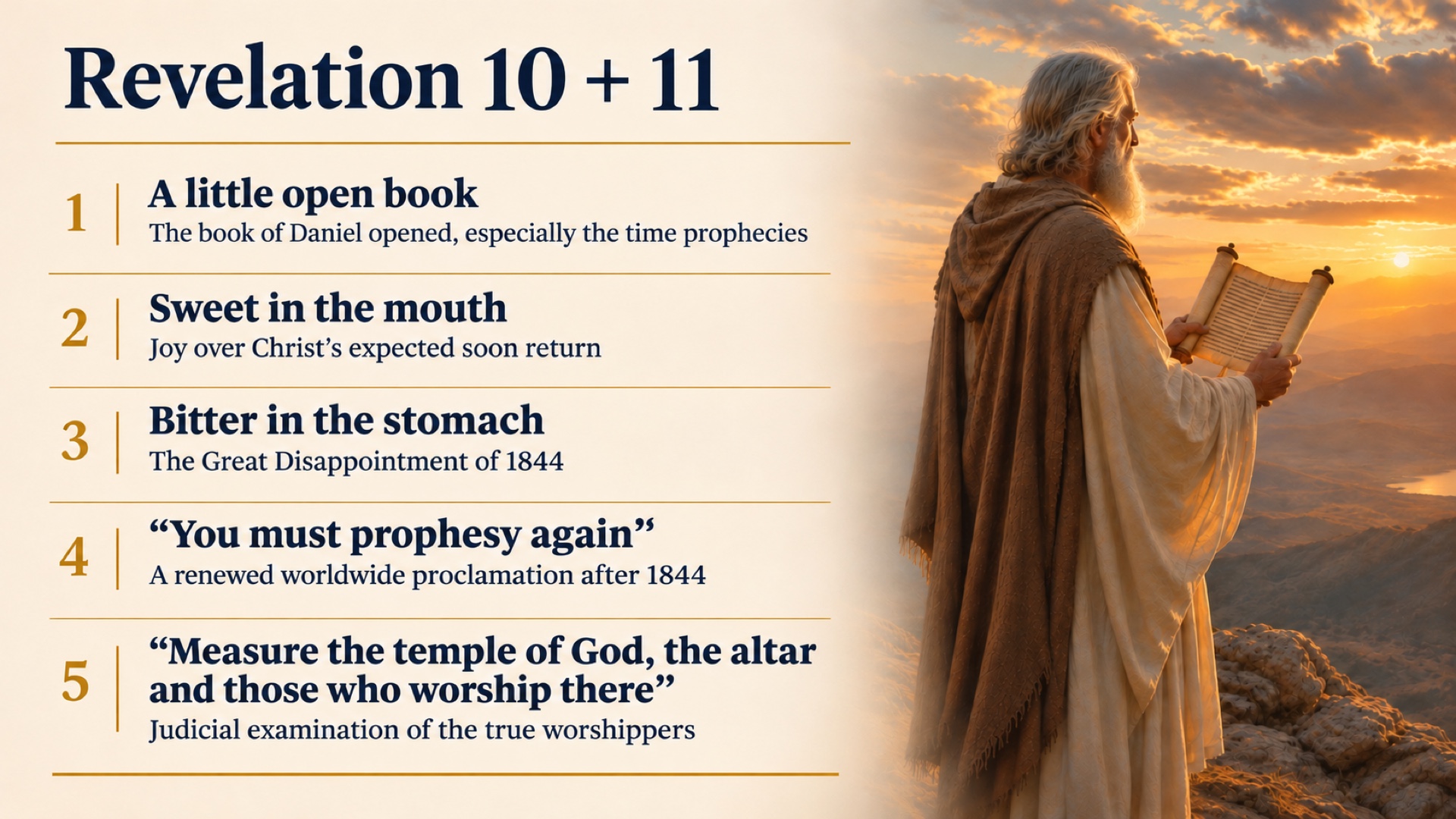
The fact that this book is open is significant. An open book can indicate that something is becoming accessible and understandable. What was previously closed or sealed can now be understood.
We think here particularly of the prophetic word and the time periods in the book of Daniel. Connections that had long remained obscure become clear through the study of Scripture.
John is told to take the little book from the angel’s hand and eat it. He receives an unusual warning: it will be as sweet as honey in his mouth, but it will turn bitter in his stomach.
That is exactly what happens. John takes the little book and eats it. At first it tastes sweet; afterward, it causes bitterness.
The Sweet Message of Jesus’ Return
As the pioneers of the Advent movement studied the prophetic time periods, especially those in the book of Daniel, they were filled with excitement. They were convinced that Jesus would come soon. At last, suffering on this earth would come to an end.
This hope filled them with joy. They organized large gatherings and camp meetings. Thousands came to hear the message.
The preachers were filled with the love of Jesus and the love of God, and they shared that love with others. Large numbers of people responded. To them, the message was as sweet as honey.
But the imagery in Revelation 10 does not end with sweetness. The angel had announced that the little book, once eaten, would turn bitter in the stomach.
The early Advent believers likewise experienced a profound disappointment. The anticipated event did not take place as they had understood it would.
The movement was fundamentally headed in the right direction. But the announced event needed to be understood differently. This experience brought great bitterness.
What had once been sweet became painful—it became bitter.
After the Disappointment, the Mission Continues
The disappointment, however, does not mark the end. In Revelation 10:11, John receives a further commission:
“You must prophesy again concerning peoples and nations and languages and many kings.”
There is encouragement in these words: Get up again. Continue proclaiming the message. Your ministry is not yet finished.
The bitter experience does not cancel the mission. Rather, after the disappointment, the believers are to move forward and bring the message to the people once again.
Revelation 11: The Temple of God Is Measured
Immediately afterward, we read in Revelation 11:1:
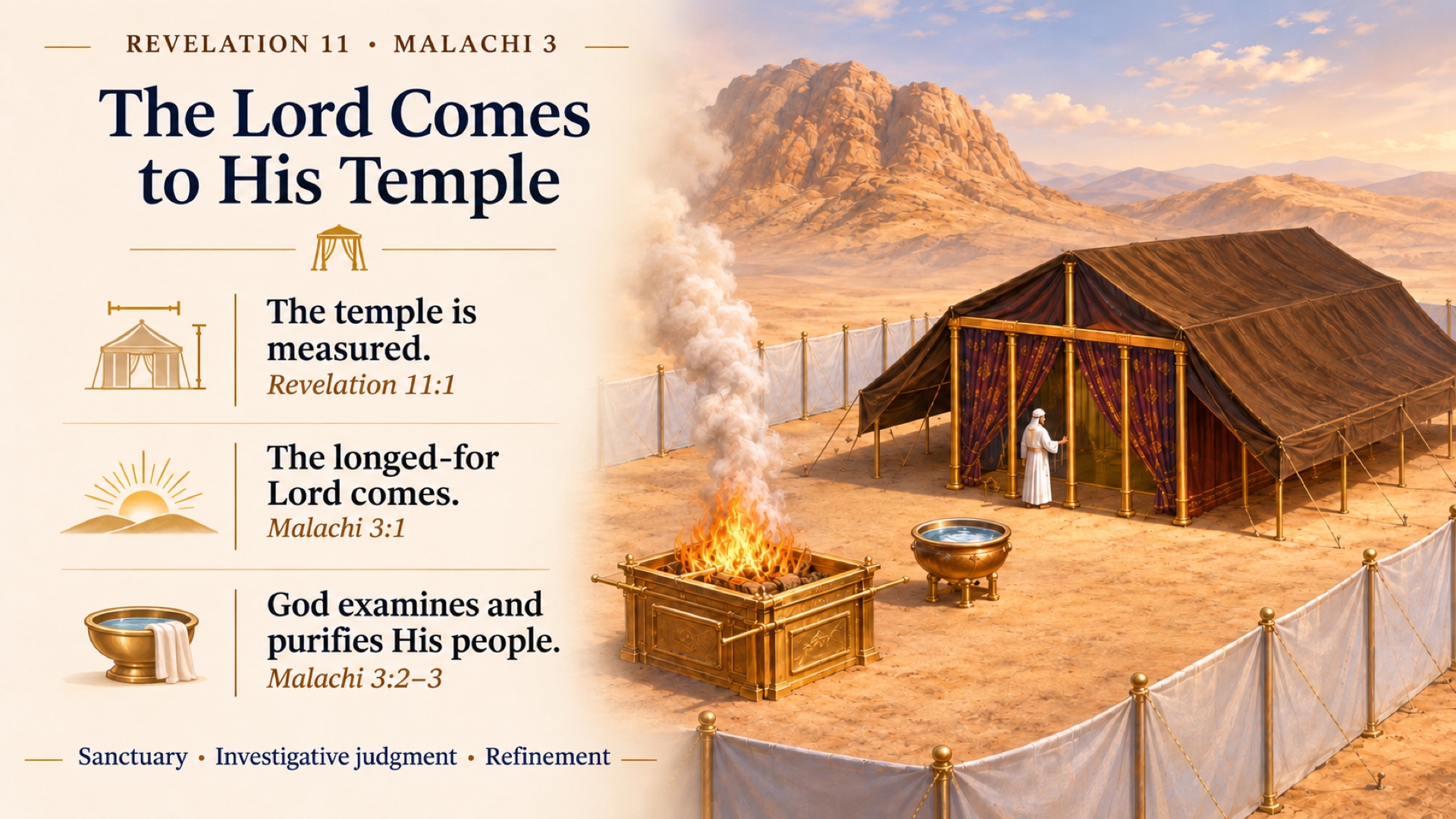
“And I was given a reed like a measuring rod and was told: Rise and measure the temple of God and the altar and those who worship there.”
Our attention is thus directed to the temple of God, the altar, and the worshipers.
Where do we, as Seventh-day Adventists, turn in faith? Where do we see Jesus carrying out His present ministry?
According to Adventist understanding, Jesus ministers in the Most Holy Place of the heavenly sanctuary. Our faith is directed toward Him.
The measuring of the temple and those worshiping in it is associated with the investigative judgment. It calls to mind the opened books and God’s examination in judgment.
A connection thus emerges between Revelation 10 and 11: joyful expectation is followed by bitter disappointment. Then comes a renewed commission to proclaim the message, and attention is directed to the temple of God and those worshiping in it.
Can we recognize in this the experience of the Advent movement and the message of the investigative judgment? The Adventist understanding presented here makes precisely this connection.
Malachi 3: The Lord Comes to His Temple
A third passage takes us to Malachi 3. Verse 1 says:
“Behold, I am sending My messenger, and he will prepare the way before Me.”
This passage is also understood as applying to the time of the end. Before the Lord comes, He sends a messenger to prepare His way.
We think first of John the Baptist and his disciples. They prepared people for Jesus, even though they, too, still shared the expectation that the Messiah would break the Roman yoke. Their limited understanding did not cancel their mission as forerunners.
Similarly, William Miller and the preachers of the early Advent movement proclaimed the imminent coming of Jesus. They longed for Him and for reconciliation with God. Full of joy, they announced His return and expected Him to free the world from Satan’s yoke once and for all.
But the announcement in Malachi 3:1 directs our attention to a different event:
“And suddenly the Lord whom you seek will come to His temple, and the Messenger of the covenant in whom you delight.”
The long-awaited Lord suddenly comes to His temple. The word “suddenly” emphasizes the unexpected nature of His coming: the believers anticipated a particular event, but His coming took place differently from what they had understood.
According to Adventist understanding, Jesus did not return to the earth at that time. Instead, He entered the Most Holy Place of the heavenly sanctuary. There He began His final ministry of cleansing the sanctuary from sin. This ministry is also connected with the cleansing of the hearts of believers and of His church on earth, preparing them for His return.
Thus, despite its misunderstanding of the anticipated event, the early Advent movement fulfilled a mission as a forerunner. As with John the Baptist, its understanding was still incomplete, yet its preaching called people to prepare to meet Jesus.
The Messenger of the covenant is understood to be Jesus. He is the Lord whom the believers sought and longed for. Their longing was directed toward the right Person; however, they needed to gain a deeper understanding of the meaning of His coming. Malachi’s words point to the unexpected event: the long-awaited Lord came to His temple.
Refined Like Gold and Silver
Malachi goes on to ask who can endure the day of His coming and who can stand when He appears. He then describes the Lord using two images: a refiner’s fire and a launderer’s soap.
The Lord sits as a refiner and purifier of silver. He purifies the sons of Levi and refines them like gold and silver.
Here again we encounter the idea of examination and purification. This refining process is connected with the investigative judgment. It involves letting go of sin and allowing God to cleanse us.
In my understanding, and that of many others, these three passages point to the Advent movement: Revelation 12, Revelation 10 and 11, and Malachi 3.
They help us understand our history, our message, and our mission in the light of the Bible.
The Spirit of Prophecy in the Great Controversy
Let us return once more to Revelation 12. The dragon wages war against the remnant of the woman’s offspring. These people are distinguished by keeping God’s commandments and having the testimony of Jesus, the spirit of prophecy.
We therefore remain involved in a great controversy.
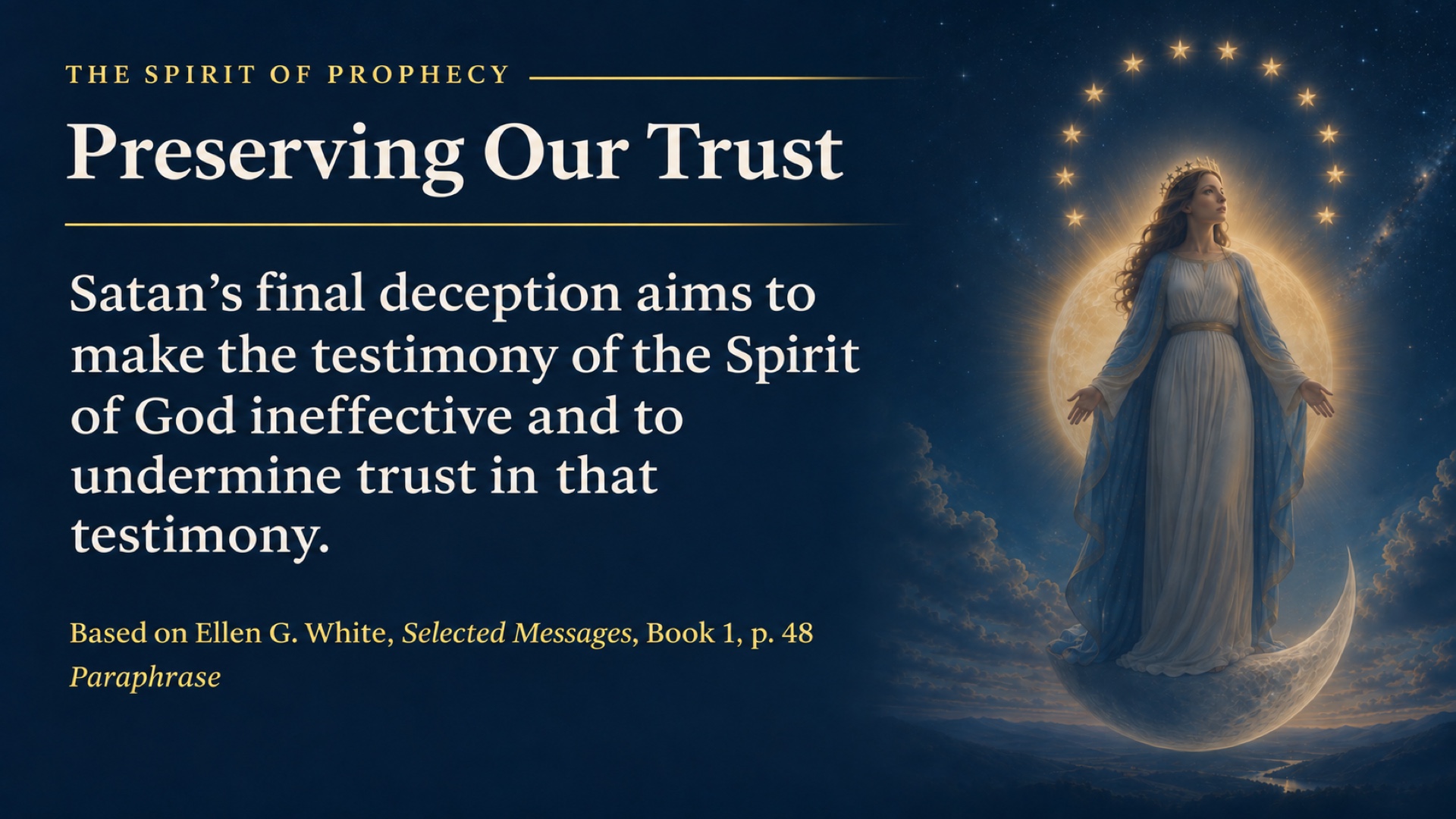
In Selected Messages, Book 1, p. 48, Ellen White warns that one of Satan’s final deceptions will be to make the testimony of the Spirit of God ineffective. In subtle and varied ways, he will attempt to shake the remnant’s confidence in the true testimony.
What does it mean to make this testimony ineffective?
A message can be present and yet no longer have any influence on our lives. It may still be spoken or printed, but hardly taken to heart.
There is more than one way in which confidence can be lost. Different people are susceptible in different areas.
When Doubts Are Passed On
One way this can happen is when people searching for truth come across statements they do not understand. Their search may be sincere. Nevertheless, connections they do not understand can give rise to doubts.
These doubts are passed on and find receptive ears and hearts in others. In this way, confidence in the testimony can be shaken.
The question, therefore, is how we deal with what we do not yet understand, and whether we remain willing to seek God’s will.
When We Possess the Testimony but Do Not Heed It
Another way is less obvious. We may say: We have the testimony of Jesus and the spirit of prophecy. But we do not read the relevant writings.
Or we read only the simple and pleasant statements. When the message calls for changes in our own lives, however, we shut it out.
This, too, makes it ineffective. We can profess belief in a gift from God while giving it little room to shape our thoughts and actions.
God wants us to stand firm. He wants us to hold to the characteristics of the remnant and not allow ourselves to be shaken.
The Lesser Light Leads to the Greater Light
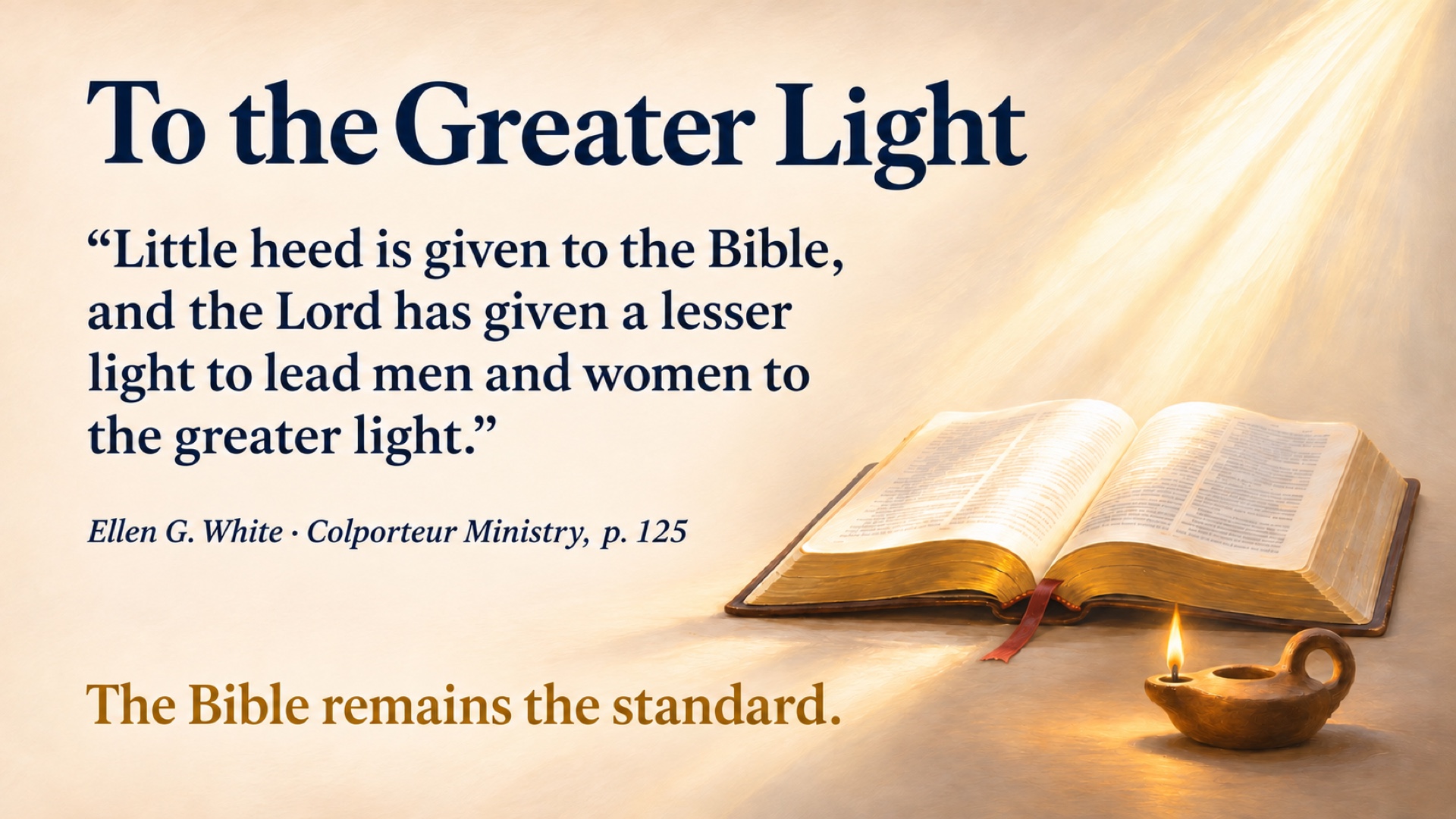
Ellen White also writes that little attention is given to the Word of God. For this reason, the Lord has given a lesser light to lead men and women to the greater light.
The greater light is the Bible, the Word of God itself.
A crucial principle follows from this: the lesser light must always be tested by the greater light. It must be open to examination in the light of the Bible.
The spirit of prophecy is intended to lead us to God’s Word. Trust and examination therefore belong together. The Bible remains the standard.
Knowing and Doing God’s Will
What is ultimately at stake in this conflict? Why is there an attempt to shake confidence in God’s testimony?
Satan’s goal is to keep people from being saved. This conflict therefore concerns the way we live out our faith.
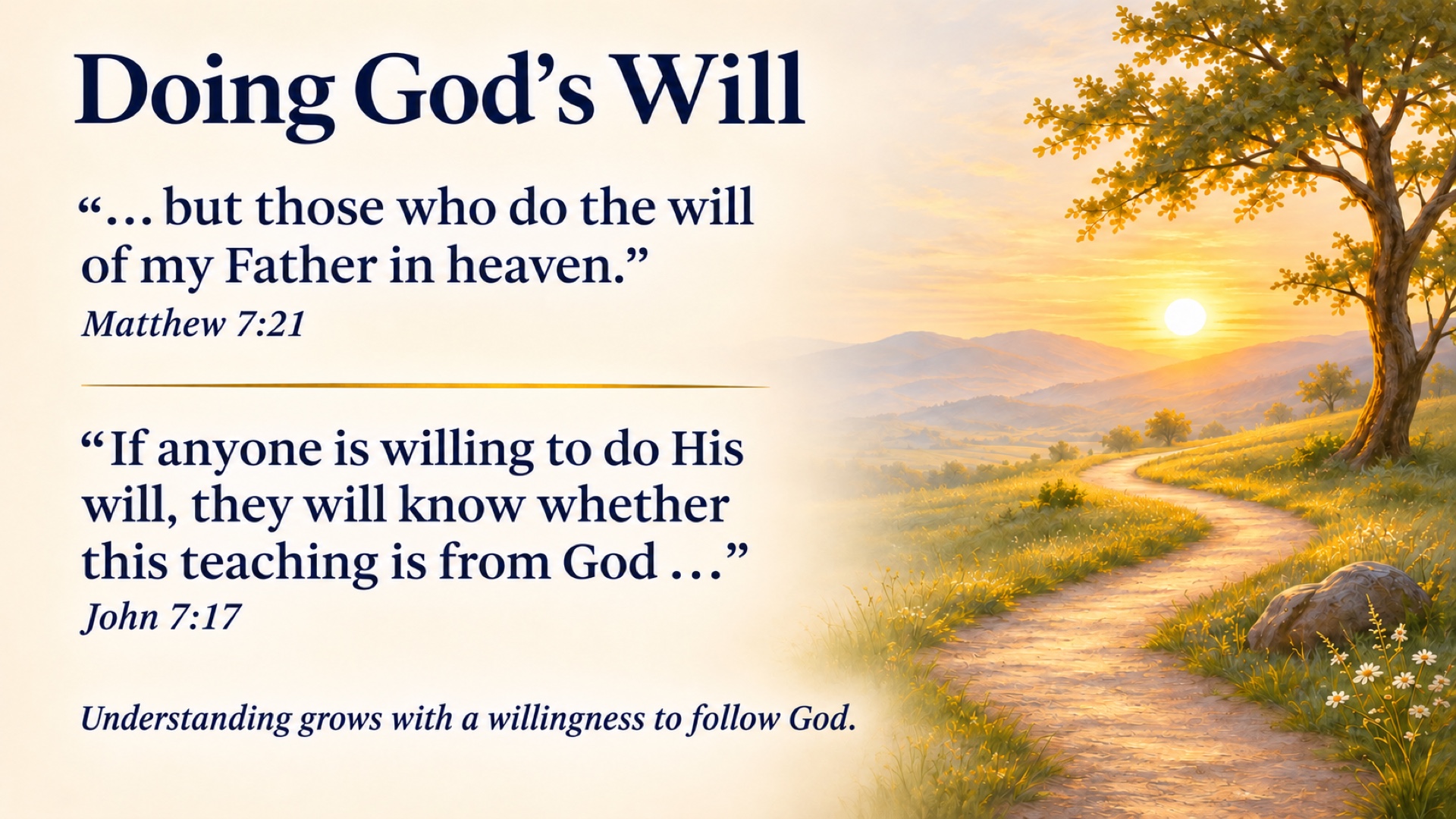
In Matthew 7:21, Jesus says that not everyone who calls Him “Lord, Lord” will enter the kingdom of heaven, but those who do the will of His Father in heaven.
The Bible and, according to Adventist understanding, the spirit of prophecy also show us this will. They make clear what God desires and what is contrary to His will.
If we lose confidence in these messages, stop reading them, and no longer take them to heart, we are in danger of losing sight of God’s will and ceasing to act upon it.
That is why this question is so personal: Do we allow God’s Word to speak to us and change us?
A Promise for Those with Unanswered Questions
Perhaps uncertainties remain. How do particular statements fit together? How do we deal with apparent contradictions? How can we recognize whether a teaching comes from God?
In John 7:17, Jesus gives us a wonderful promise: anyone who is willing to do God’s will will recognize whether the teaching comes from God.
We can take this assurance to heart. It connects understanding with a willingness to do God’s will.
Why do some people accept God’s revelation while others do not? One reason may lie in what they are willing to accept. Our own desires, preferences, and dislikes influence our decisions. We may want to hold on to one thing and avoid another.
God does not remove every uncertainty from His Word or eliminate every possibility for doubt. He gives us sufficient reasons to trust Him, but He also leaves some questions unanswered. It is precisely here that our willingness is tested: Do we truly want to do His will, even when we do not yet understand everything? Yet those who are willing to do God’s will can trust His guidance.
May He grant us this willingness: a heart that desires to know and do His will.
Overcoming Through the Blood of the Lamb
In closing, we return to Revelation 12:11:
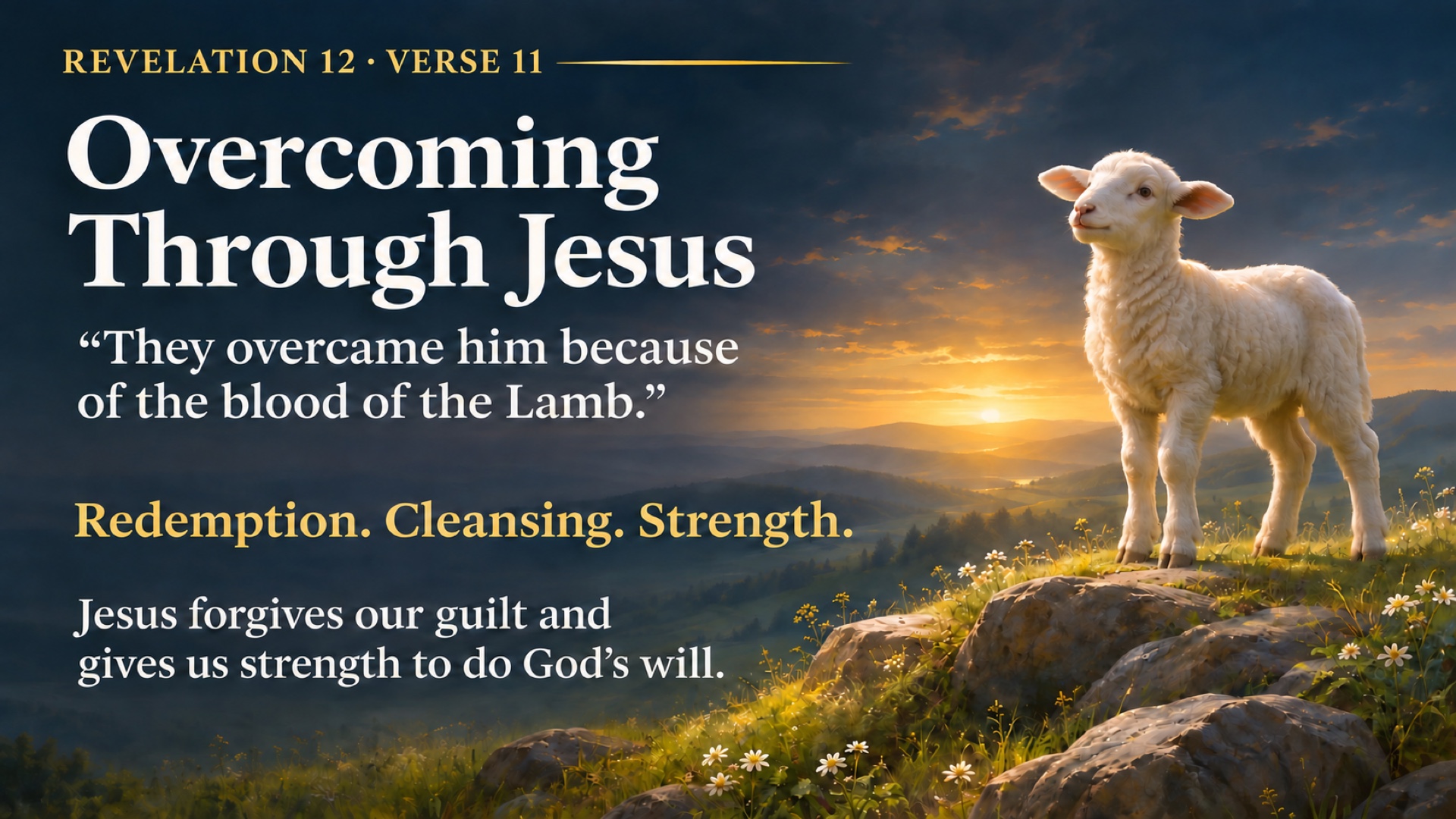
“They overcame him because of the blood of the Lamb.”
We, too, want to overcome through the blood of the Lamb. But these words should not remain merely an expression of faith. What do they mean in practice?
The blood of the Lamb redeems us. Jesus pays the debt of our sin. But His redemption reaches further: His blood also cleanses us.
He forgives us and gives us the strength to overcome. Through Him, we can do the Father’s will if we are willing.
Our study of the Advent movement in the Bible thus leads us back to Jesus Christ. He is the victor in the great controversy. He sustains His church, forgives its sins, and cleanses it.
May God grant us a fresh experience with Him. May we better understand why we are Seventh-day Adventists and be able to explain the biblical basis of our faith.
May we take these foundations to heart, live by them in our daily lives, and thereby become a blessing to others.
All images were created with the help of AI (ChatGPT).
Leave a Reply