

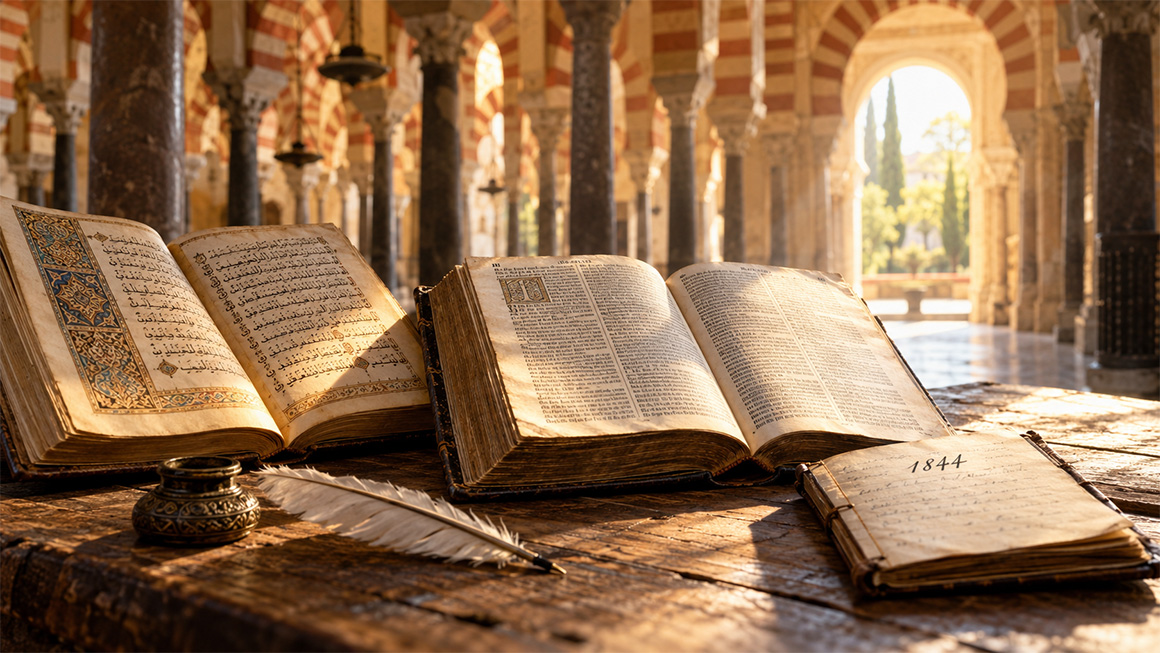
What connects the Islamic world, the Reformation, and the Adventist movement? A historical trail leads from Córdoba to 1844—and to three principles of spiritual freedom: freedom of conscience, freedom of inquiry, and direct access to God. By Kai Mester
Reading time: 19 minutes
There is a curious tension in Christian history.
It began with a surprisingly simple call:
- Test everything. Test the spirits.
- Study the ancient Scriptures and contemplate creation.
- Follow God rather than people.
This was about more than simply examining individual doctrines. People were to recognize and discern for themselves and take responsibility before God—rather than blindly relying on human authority.
But what happened to this attitude over the course of history?
The persecuted church of the first century gradually became a powerful institution. After Constantine, Christian faith, political order, and ecclesiastical authority became increasingly intertwined.
A system emerged in which the interpretation of the Bible was increasingly mediated by tradition, ecclesiastical offices, and institutional structures.
From an Adventist perspective, this marks a decisive turning point in the history of salvation.
Rome had become the center of Christian power. Anyone who defied the church’s doctrinal authority—whether on matters of faith, worldview, or scientific knowledge—and relied on their own conscience and judgment faced persecution and death as a heretic.
The problem, therefore, was not merely what was believed. It was also the question of who was permitted to decide what must be believed.
And then a new force entered the stage of history.
In the 7th century, Islam emerged in the east and south of the Christian world.
Its holy scripture, the Quran, emphasized three spiritual principles with unusual clarity:
- Think for yourself and examine.
- Return to revelation.
- Place God alone above all human authority.
Exactly what was so central to early Christianity. This raises a surprising question:
Could God, in His providence, have even used a religious movement outside of Christianity to bring elements of a lost spiritual attitude back into view?
This question becomes even more interesting when one looks not only at theology but also at history and culture. Through centers such as Córdoba and Toledo, numerous works and intellectual impulses found their way into the Latin West. The influence of the Islamic world on Europe and the entire Western world can still be traced in many areas today.
Is there a clue here?
From Córdoba to Toledo to European intellectual history, and from there to the Reformation and finally to the Adventist movement, we can trace a line of development in which the same fundamental question arises again and again:
May human authority rule over the conscience—or must human beings themselves return to revelation and obey God rather than people?
It is precisely this trail that we wish to follow.
The Three Principles of Spiritual Freedom
1. Examine for Yourself—Freedom of Conscience
The Quran explicitly opposes the idea that a belief is true simply because one’s ancestors held it.
“When it is said to them, ‘Follow God’s revelation,’ they say, ‘We follow the traditions handed down to us by our fathers.’ They do this even though their fathers did not use their reason and lacked guidance.” (Sura 2:170)
The message is significant: It is not the traditions of the fathers that matter, but reason and guidance!
Elsewhere, the Qur’an encourages listening, reflecting, and examining: “Those who listen to whatever is said and follow only the best of it—that which leads to God. These are the ones guided by God, and they are the ones who possess understanding.” (Surah 39:17–18 Azhar)
And personal responsibility for knowledge is explicitly emphasized: “You shall not claim to know something if you do not know it. Everyone will be held accountable before God for what they hear, see, and understand.” (Surah 17:36)
Hear. See. Think. Examine.
Knowledge is not a trivial matter in the Qur’an. One should even ask for it: “Say: ‘O Lord! Increase my knowledge!” (Sura 20:114)
And time and again, the Quran points to creation as a subject for reflection: “In that are signs for people who reflect.” (Sura 13:3)
These are remarkable foundations for a culture in which knowledge, observation, reasoning, and research were able to gain such prominence.
This principle has shaped Islam and led it into its Golden Age. Some 700 years of scientific, cultural, and intellectual flourishing. Medicine, mathematics, astronomy, philosophy, optics, and numerous other fields of knowledge were explored, developed, and passed down. Cities such as Baghdad and Córdoba became centers of learning.
Above all, however, one rule applied: No intermediary was allowed to interpose himself between man and God. Consequently, there was a freedom of expression (Ikhtilāf) and a pronounced culture of debate (Kalām) unknown in the Christian Middle Ages. As long as one did not speak against God, Muhammad, the Quran, or the caliph, just about anything was permitted. There was also a great deal of tolerance and religious freedom.
What a contrast to Roman Europe! While the European nobility in the early Middle Ages often could not even write their own names and emptied their chamber pots onto unpaved streets, the citizens of Córdoba and Baghdad read scholarly works on cheap paper—and washed themselves several times a day in marble baths with fragrant soap. That may be somewhat simplified and exaggerated, but it still gets to the heart of the matter.
But let’s move on to the second principle:
2. Back to the Source—Freedom of Research
“Ask the scholars of the Scriptures if you do not know! We sent them before you with clear proofs and the Books. We have sent down the Quran to you so that you may clearly proclaim to the people the revelation intended for them, that they may reflect.” (Surah 16:43–44)
“If you have any doubt about the revelation We have sent down to you, ask those who have been reading the Book before you! The truth has certainly been conveyed to you from your Lord, so never be among the doubters!” (Surah 10:94)
From this, Islam developed, among other things, the methodology of ijtihad: the serious intellectual effort to arrive at a well-founded judgment based on the authoritative sources, using reason and expertise. The word shares the same Arabic root as jihad —effort or commitment. While jihad describes outward commitment, ijtihad refers to the intellectual effort toward knowledge and judgment.
This does not mean the abolition of scholars. Rather, it means limiting their authority.
A scholar can explain. A teacher can instruct. A judge can render a judgment. But no human being thereby becomes God.
The Qur’an also calls for the study of nature: “In the creation of the heavens and the earth and the alternation of night and day are signs for those who use their reason … those who reflect on the creation of the heavens and the earth and say, ‘Our Lord, You did not create all this in vain. Praise be to You!’” (Sura 3:190)
“Travel throughout the earth and see how He brought creation into being!” (Sura 29:20)
3. God Alone—Freedom from Human Religious Rule
This is the core.
The Islamic concept of Tawḥīd signifies the unity and oneness of God. If God alone is God, then no human institution can take His place.
The Qur’an states this with great clarity:
“That we worship God alone, worship no one besides Him, and that some of us do not take others as their lords in place of God!” (Surah 3:64)
And it states even more forcefully:
“They took their scribes and monks as lords besides God…” (Sura 9:31)
Not rulers, priests, scholars, or tradition. Not the majority. Not even one’s own reason.
Man should use his reason, but not deify his reason.
He should examine tradition, but not elevate his own opinion above it.
He should listen to scholars, but not place them in God’s stead.
He should seek revelation—and give God alone the ultimate authority.
These three principles become the key to further reflection. For they shook the very foundations of papal Rome.
The big question: What happened to these principles in Christianity?
Early Christianity certainly recognized them in a different form. The New Testament writings call for discernment. Jesus preached, “You will know them by their fruits.” Paul writes, “Test everything; hold on to what is good.” (1 Thessalonians 5:21) and John: “Test the spirits to see whether they are from God.” (1 John 4:1)
The Bereans are praised for examining the Scriptures themselves to see if what they heard was actually true (Acts 17:10–11). A Christian, then, should not simply believe because some person says so.
But the history of the Church took a different turn.
As the connection between the Church and Roman state power grew, the social standing of Christianity changed fundamentally.
The church became an institution. The institution became the social order. And the social order required authority.
Consequently, the importance of the office of bishop, church tradition, binding doctrinal decisions, and ultimately a comprehensive church system grew.
What happens when an institution makes itself the standard by which revelation is measured?
It is precisely at this point that later history can be read as a divine counter-movement. For now God demonstrated His mercy by answering Abraham’s prayer for Ishmael and using his descendants—just as He had done in the past with Joseph and Moses—to intervene salvifically and turn the course of history once again from darkness toward the light.
Ishmael—The Forgotten Side of the Promise
The Bible contains a remarkable promise. God says to Abraham concerning Ishmael: “And as for Ishmael, I have also heard you. Behold, I have blessed him and will make him fruitful and multiply him exceedingly.” (Genesis 17:20)
Ishmael was to produce twelve princes who would grow into a great nation. This simply means, first of all, that God does not reject Ishmael. He is not outside the scope of divine providence.
When considering the later history of Islam against this backdrop, a faithful reader might therefore ask:
Could God have used the descendants of Ishmael in His providence for a special historical mission?
From an Adventist perspective, one might ask whether the trumpets in Revelation can help us answer this question.
The Fifth Trumpet—Locusts from the East
Already in the introduction to the trumpets, we encounter incense on the golden altar (Revelation 8:3) —symbols that are prophetically closely linked to the gifts of the sons of the East (Isaiah 60:6): gold and frankincense. We think of the Magi from the East and the Queen of Sheba, those descendants of Ishmael who have become famous.
Then, with the fifth trumpet, a different horizon suddenly opens up. From the smoke of the Abyss, a mighty, otherworldly power rises. John describes them as locusts—but these are no ordinary locusts. Their faces are human, their hair like that of women, their teeth like those of lions, and their breastplates like iron. Above them stands a king, the “angel of the abyss” (Revelation 9:11).
It is a imagery that appears at once military, political, spiritual, and downright demonic.
Why locusts, of all things?
In the prophetic language of the Bible, locusts repeatedly appear as a symbol of mighty nations and armies from the East. Joel describes an army that sweeps across the land like a locust plague. In connection with the sons of Ishmael and the peoples of the Arab world, this creates a striking pattern.
This pattern was also taken up by classical Protestant and Adventist interpreters. They understood the fifth and sixth trumpets as prophetic images related to the rise of Islamic powers. For the sixth trumpet, Adventist pioneer Josiah Litch developed a calculation of “one hour, one day, one month, and one year” equating to 391 years and 15 days—an interpretation he applied to the Ottoman Empire and which, astonishingly, was fulfilled to the very day in 1840.
But this is where it gets fascinating:
For Rome, the emergence of this foreign power must have seemed like a catastrophe. Smoke darkens the sun. Scorpions torment with their venom. Destruction rises from the abyss, led by the devil himself, who has fallen from heaven. A mighty power threatens the existing order.
And indeed: In the apocalyptic logic of Revelation, the seven trumpets bring Babylon (Rome) to its knees because it had set itself in God’s place and become a persecuting power. Just as Jericho once fell under the seven marches of Israel, so the Book of Revelation brings the story to a climax in seven trumpets. The seven circuits around Jericho during the seventh march are mirrored in the Book of Revelation by the seven plagues of the seventh trumpet.
Yet what appears to be the city’s downfall is also meant to be the beginning of something new: the incense from the desert brought enlightenment. The medical research of the “Locusts” even brought relief and healing, inspired by a messenger who had received a key: a biblical message in the Quran, albeit greatly condensed, concentrated, and cast into Arabic poetry—yet all the more powerful to this day.
What if the fifth trumpet were to speak not only of military power, but of a historical movement through which God brought about a specific spiritual counterforce to the ossified Christian world order?
The Paradoxical Role of Islam
Herein lies the paradox. Islam did not emerge as a Christian reform movement. Although its teaching about Jesus is more biblical than many Muslims realize, it is nevertheless not proclaimed as centrally and essential to salvation as it is in the New Testament. In Islam, it remains veiled to this day.
And yet Islam introduced into history a religious culture that emphasized certain points with extraordinary consistency:
God alone. Revelation. Scripture. Personal responsibility. Reason and scrutiny. Rejection of the deification of human authority.
No alcohol, no priests, no pope, no confession, no celibacy, no veneration of Mary, no worship of images, no veneration of saints or relics, no unclean meat, no original sin, no monopoly on education and knowledge.
Is a stronger and more precise critique of Roman Christianity even conceivable? In fact, this is likely why Catholicism could hardly gain a foothold in the East.
From a Christian perspective, one might therefore see this as a peculiar form of divine providence:
God did not necessarily have to inspire a movement endowed with the full truth. He could nevertheless use it in His providence to shape history.
This would be comparable to the biblical principle that God also includes people and nations outside of Israel in His historical plan.
Córdoba: When Thoughts Turned Toward Europe
Then comes al-Andalus (Spain). Conquered by Tāriq ibn Ziyād in 711 on behalf of the Umayyad Caliphate. Incidentally, Gibraltar is still named after this military commander today (Mount Tāriq = Jabal Tāriq). Two centuries later, the Spanish city of Córdoba became one of the major centers of Arabic-language scholarship.
But the decisive development extended far beyond Córdoba alone. Over the course of centuries, philosophical and scientific works from Persian, Greek, Indian, and Syrian traditions were translated, annotated, systematized, and further developed in the Arabic-speaking world.
Later, these texts made their way into the Latin world via Spain, Sicily, and other intermediary regions.
In the 12th century, Toledo became an important center for the translation of Arabic works into Latin.
The impact was profound. Europe received not only new texts; it also received new philosophical questions, new categories, new forms of argumentation, and new ways of reading Greek literature. New ideas about how science could be systematically organized.
The influence of Arab-Islamic philosophy on the Latin world is well documented historically.
And this brings us back to our original topic:
It was not only the answers that were transmitted; a culture of questioning was also transmitted. People got a taste of Islam’s freedom of expression and tolerance. They had, so to speak, gotten a taste for it.
Of course, this picture is an exaggeration: Islamic societies, too, experienced power struggles, religious boundaries, and periods of repression. Nevertheless, the contrast with the West was dramatic.
When Freedom Breaks Away from God
Herein lies perhaps the greatest paradox in all of history.
A person learns: Examine tradition. Then he examines the Church. Then he examines the Church’s doctrinal decisions, philosophy, and metaphysics. And at some point, he asks the question: Do I even have to believe in God anymore?
Thus, spiritual liberation can also give rise to secularization.
European modernity indeed illustrates this development: reason, criticism, science, and individual freedom of conscience were increasingly able to break free from their original religious premises.
And that led to a fatal wound. The scorpion’s sting had shifted from torment to ultimate death. The Eastern “poison” (from Rome’s perspective)—this free and critical thinking—unfolded an unforeseen, revolutionary dual effect in the West: Reformation and Revolution
In 1798, this drama of world history reached its climax: French General Berthier marched into Rome, took the Pope prisoner, and dissolved the Papal States after more than a thousand years of existence. From an Adventist perspective, the hour of prophecy struck at precisely this moment.
On the one hand, the symbolic smoke from the abyss had brought forth the knowledge-hungry hordes of horsemen from the East. If we interpret the imagery of the locusts not only militarily but also spiritually, surprising parallels emerge:
- “crowned” with knowledge and wisdom;
- endowed with an intelligent “human face”;
- fascinating and seductive like long “women’s hair”;
- unstoppable thanks to the “lion’s teeth” of analytical thinking;
- protected by the “iron armor” of logic and equipped with the razor-sharp intellect of ijtihad;
- “inspired” by the breakneck speed with which the world’s knowledge was translated and disseminated.
On the other hand, this same abyss, unleashed by this emancipated reason in the West, now also gave rise to the murderous beast of the French Revolution, which dealt what was thought to be the death blow to Rome’s absolutist claim to power in 1798.
Thus, the same capacity can take two different paths:
One path:
Examination → Revelation → God.
The other:
Examination → Criticism → Autonomy → Secularization.
From this perspective, one could say:
Europe learned to think critically—but the decisive question was whether critical reason would make itself or God the ultimate standard.
The Reformation: Europe Rediscovers Its Source
Persecuted Jews and Christian heretics had found refuge in the Orient. They made up a significant portion of the translators who brought the knowledge of antiquity into Arabic and translated Arabic scholarship into Latin. Europe was bleeding intellectually and economically, but through these survivors, it regained the foundation for its own later scientific Enlightenment.
The Reformation arrived as early as the 16th century. It reframed the question of authority. The central Reformation tenet, sola Scriptura, declares Holy Scripture to be the binding standard of faith. With this, a motif reemerges that structurally resembles our three pillars:
Examine human tradition.
Return to Scripture.
Place God above the ecclesiastical institution.
This is not, admittedly, the thinking of all of Islam. But it is astonishingly similar to its way of thinking.
The Reformation was only the beginning
Yet even the Reformation did not stand still. In English and American Protestantism, movements arose time and again that asked: Why stop at the Reformation?
If the church needed to be reformed—why not return to original apostolic Christianity? The radical reformers of the Anabaptist movements had already called for this.
This is how Restorationism arose. The Christian Connection faith community was part of this movement. It was skeptical of human creeds and emphasized the Bible and the personal examination of Scripture. It rejected all authority of the bishops and all decisions of the councils. “Back to the Roots.” “Back to early Christianity” was its motto.
Several individuals who later played a decisive role in the Adventist movement came from this background. Among them were Joseph Bates, Joshua Himes, and James White.
Now our triad begins to close once again:
Examine.
Return to the source.
Limit human authority.
The Sixth Trumpet: The End of the Old Order?
The classic Adventist interpretation identified the sixth trumpet specifically with the Ottoman Empire and linked the prophetic time frame of 391 years and 15 days to the year 1840.
Josiah Litch and the Year 1840
In 1840, Josiah Litch published a calculation according to which the prophetic period was to end on August 11, 1840. At the time, the event was associated with the decline of Ottoman power and attracted considerable attention within the Millerite movement. This is because the prediction came true to the exact day, strengthening confidence in the “year-for-a-day” principle that William Miller had used in his calculation for 1844.
This creates a chronological bridge in the classical Adventist interpretation:
fifth trumpet → Islamic expansion
sixth trumpet → Ottoman power
end of the prophetic period → 1840
afterward → Adventist movement
And now we come to Revelation 10.
Revelation 10: The Book Is Sweet—and Bitter
Toward the end of the sixth trumpet, a mighty angel appears. In his hand is a small, open book. John takes the book and eats it. It tastes sweet in his mouth. But in his stomach, it turns bitter. Then he receives the command:
“You must prophesy again about peoples and nations and languages and many kings.” (Revelation 10:11)
The early Adventists saw in this a remarkably accurate depiction of their own experience. The message of Christ’s imminent coming was sweet to the Millerites. The anticipation of the year 1844 filled them with hope.
Then came October 22, 1844. Christ did not appear as they had expected. Joy turned to bitterness. And yet the story did not end there.
The Adventist pioneers understood Revelation 10 specifically as an indication that the disappointment was not the end, but rather the transition to a new mission: “You must prophesy again.”
This is arguably the most extraordinary self-understanding of any religious movement.
The bitter experience became a touchstone
Something crucial happens here. The small group that continued studying after 1844 did not say, “Our method was wrong, so everything is wrong.”
Rather, they said, “We must examine the Scriptures once more.”
The Adventist Church thus emerged from an intensive re-examination of the Bible following that disappointment. This led to insights regarding the biblical sanctuary service and the investigative judgment, regarding sealing and the Sabbath, about the condition of the dead and the resurrection, about the three angel messages, health reform, and the importance of a holistic lifestyle, about righteousness by faith and overcoming sin, about the final outpouring of the Holy Spirit, the Loud Call, and much more.
These are precisely the three principles:
Examine. Return to the source. And: the ultimate authority is God and His Word.
And with that, the circle is complete
It now becomes clear why the fifth trumpet sets in motion a dynamic that continues into the sixth trumpet and transitions seamlessly into the chapter interpreted as the beginning of the Adventist movement. It is the biblical principles of freedom of conscience and religion, freedom in research and science, and freedom of direct access to God that connect Islam and the Adventist movement. Once upheld in early Christianity, then lost through Roman state Christianity, it took the Islamic Golden Age to provide the impetus for a turning point in the Dark Ages.
And even though this impetus ultimately led to a polarization between secular postmodernism and a renewed, Bible-faithful Christianity, it was nevertheless necessary to present all people with the free choice between the seal and the mark mentioned in Revelation.
Freedom, then, can lead in two directions: toward autonomy from God or toward a free choice for God.
Perhaps, out of gratitude for Islam’s mediating role in this historical development, we may encounter our Muslim brothers and sisters in a whole new way. For religious freedom is an expression of deep respect for my neighbor. What has been given to us, we, too, may pass on to others.
The end-time message of the three angels warns the entire world against “Babylonian” coercion in matters of faith and conscience through the mark of the beast. It invites us to study God’s freedom-affirming way of thinking in His creation and to voluntarily choose His natural order and His atmosphere of patience and trust.
The message of the three angels applies not only to each reader personally but explicitly concerns all nations, tribes, languages, and peoples. This includes the Arab world as well—specifically the tribe of the Quraish, to which not only Muhammad belonged but also members of today’s Jordanian royal family. And it includes the entire Islamic ummah as a transnational “people.”
Let anyone with ears listen!
Leave a Reply