

Samson and the power of God: He could tear gates out of city walls and shake entire cities. Yet his hardest stronghold lay within. A story of extraordinary strength, hidden captivity, and the power that truly sets us free.
By Stephan Kobes · Reading time: approximately 15 minutes
It is the middle of the night. Gaza is asleep. Only at the city gate are men waiting for morning. They know Samson is in the city. The gates are shut, and the exits are guarded. Their plan is settled: when daylight comes, they will kill him.
Samson is trapped. Or so they think. But sometime after midnight, Samson gets up. He walks to the city gate—and then something happens that no one expected.
He does not open the gate. He takes it with him.
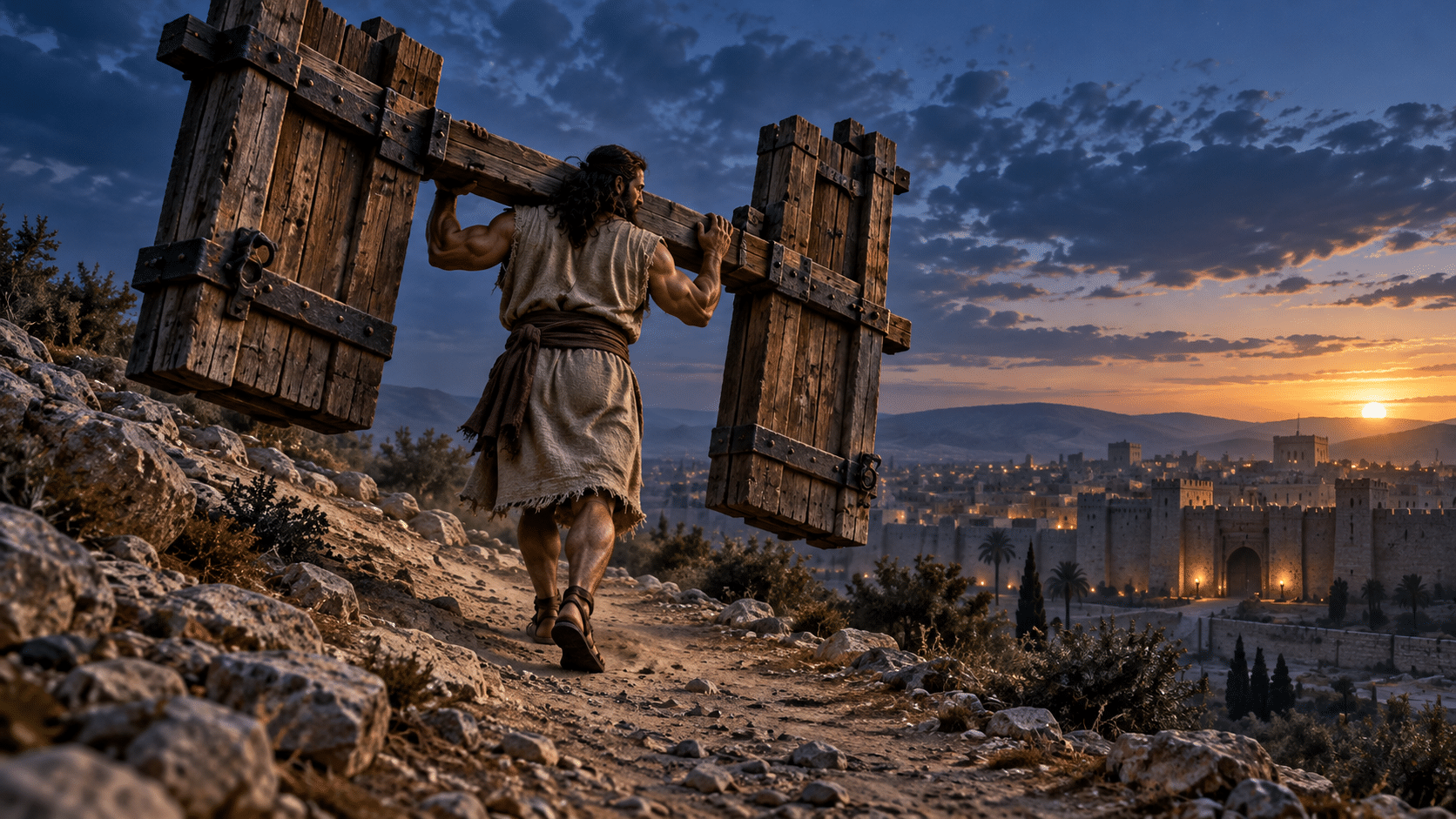
Samson grabs the two gate leaves, together with their posts and crossbar, tears the entire structure from its foundations, lifts it onto his shoulders, and starts walking.
“He took hold of the doors of the city gate and the two posts, pulled them up, bar and all, and put them on his shoulders …” (Judges 16:3)
But Samson’s feat of strength did not end at the gate. The account continues:
“… and carried them up to the top of the hill facing Hebron.” (Judges 16:3)
The gate had been torn out of the wall. But Samson now carried more than an enormous weight. An enormous journey lay ahead of him too.
Samson and the Power of God: A Night of Impossibilities
Gaza stood on the coastal plain. Hebron, toward which the biblical account directs our attention, lay roughly 60 kilometers away as the crow flies, in the hill country of Judah. Samson walks. Step by step. Beneath his feet lies the sand of the coastal plain; ahead rises the hill country—and on his shoulders rests the gate of Gaza.
The weight says: too heavy.
The night says: too tired.
The distance says: too far.
The sand says: too difficult.
The hill says: it will only get harder.
But God’s power answers every obstacle: not too great.
Samson’s strength is not spent in one extraordinary moment. It keeps carrying him—hour after hour, across great distances, despite every obstacle.
Perhaps this is a picture of the spiritual life: not only moments when walls come down, but journeys on which the impossible must be carried.
Step by step. A long journey through a land of impossibilities.
Yet sometimes we only understand what God does in a particular moment when we know what came before it.
The Walls That Made Israel Tremble
The burden on Samson’s shoulders carries more than weight. It carries a history.
Decades earlier, an entire generation had trembled at the thought of Canaan’s fortified cities.
All they could see were walls. Gates. Bars.
“The people who live in the land are strong, and the cities are fortified and very large,” the spies had reported. (Numbers 13:28)
Back then, an entire generation gave up in the face of the threat. Now, what had once filled a whole generation with fear is being carried away on one man’s shoulders. A symbol of danger becomes a monument to victory.
Are there not things today that loom before us like fortified cities, whispering, “You will never get past this”? The wall may be enormous. But it stands not only before us—it stands before God too. Even the strongest wall cannot limit his power.
Yet walls and gates do more than block a path. They also mark who holds power within their boundaries.
The Morning the Enemy Lost Its Power
In the ancient world, a city gate was far more than an entrance. It represented protection, control, and authority. Whoever overcame a city’s gate struck its power at its most vulnerable point.
The men of Gaza were certain they had Samson trapped. The gates were shut, and the exits were guarded. This time, it seemed, there would be no escape. In the morning, the captive would die. But when morning comes, the captive is not dead.
The gate is gone.
It is a picture of complete defeat: behind Samson, a huge gap stands open in the city’s defenses. What was meant to imprison and restrain him has been lifted from its hinges and carried away on his shoulders. The supposed captive has become the victor.
Yet the story of that morning brings to mind another whose victory would surpass it in every way.
A city believed it had shut Samson in. A tomb seemed to have shut Jesus in. There too, a sealed entrance was meant to keep the captive where he was. (Matthew 27:62–66) But when morning came, Jesus was no longer in the tomb. Death could not hold its prisoner.
More than that: Christ had not merely escaped death. He had broken its power. What was meant to hold him had been defeated.
“… so that through death he might render powerless the one who held the power of death, that is, the devil.” (Hebrews 2:14)
Seen in the light of the gospel, Samson’s act takes on a surprising depth. It recalls that infinitely greater morning when Christ broke the power of a far mightier prison: the grave.
Stronger Than Gaza, Weaker Than Himself
But before we leave Samson as the victor, we need to look again. The very man who broke the enemy’s power that night was not himself free. Samson had escaped from Gaza. But he needed a deeper deliverance: Gaza had to come out of Samson.
The story does not simply show how strong Samson was. It reveals how weak this strong man really was. Only moments earlier, he had risen from the bed of a prostitute.
He could overcome iron bars, but not the chains of his own desire. Samson could conquer Gaza. But Samson could not conquer Samson. That was his tragedy.
Even the Strongest Man Needs the Power of God
Gaza had lost its gate. But Samson had not escaped his inner captivity. Is that not our problem too? Perhaps the hardest strongholds in our lives are not the ones blocking our path, but the ones we carry in our hearts.
Habits that have taken root. Desires that keep returning. Pride. Bitterness. Fear of others. Selfishness. Things we may have long known do not belong in our lives—and yet they stubbornly remain.
You may speak beautifully about love, yet walk past someone who needs it most.
You may exercise iron control over your diet, but not over your tongue.
You may keep your whole house clean, yet tolerate things in your heart that should have been removed long ago.
You may lift heavy weights, yet carry the weight of a hurtful word for days.
Talent is not the same as holiness. Success is not the same as freedom.
Outward strength tells us nothing about who rules within. But who can tear these strongholds down?
Our deepest need is not Samson’s strength. We need God’s power to save.
And perhaps that is precisely where hope lies: the man through whom God displayed such power was himself a sinner. God’s power is not reserved for the perfect. It is saving power for people like Samson—and for people like you and me.
It is not merely power that tears gates from walls, but power that can tear down strongholds in our hearts. Not merely power that removes outward obstacles, but power that can loosen even the deepest bonds within us.
Here we see the true power of the gospel. Christ did not come merely to make our old life stronger. He came to give us new life. He sets captives free.
“So if the Son sets you free, you will be truly free.” (John 8:36)
But what is our deepest captivity? And why can certain things gain such power over us?
The answer lies in the way these inner strongholds are built.
The Hardest Stronghold
An inner stronghold often consists of more than a sin we refuse to release. Around it stand thoughts, beliefs, and arguments that justify why we hold on to it.
And this is what makes it dangerous: those thoughts can sound entirely reasonable to us.
It is not really that bad.
I have my reasons, after all.
That is just the way I am.
I cannot help it.
In this way, thoughts become walls behind which we resist God’s rule.
The battle for this stronghold is therefore also a battle for our thinking. Paul emphasizes this in his well-known passage to the Corinthians:
“The weapons of our warfare are … powerful through God for tearing down strongholds. We demolish arguments and every proud thing that rises against the knowledge of God, and take every thought captive to obey Christ.” (2 Corinthians 10:4–5)
Arguments. Beliefs. Thoughts. But how does God destroy a stronghold whose walls we can barely recognize anymore?
He often begins in a remarkable place. He turns on the light. He reveals not only what we do, but why we do it.
David experienced this.
When God Shines Light Within
After his adultery with Bathsheba and Uriah’s death, life initially went on. Then the prophet Nathan came to him.
But Nathan did not begin with an accusation. He told a story. A rich man had many sheep. A poor man had only one little lamb. He loved it. It grew up with his children. It ate his bread and drank from his cup. Then a traveler came to the rich man. Instead of taking one of his many animals, the rich man took the poor man’s only lamb.
David listens. His moral sense awakens. His indignation grows. Finally, he bursts out:
“As the LORD lives, the man who has done this deserves to die!” (2 Samuel 12:5)
Nathan looks at the king.
“You are the man.” (2 Samuel 12:7)
This was no sword of steel. Yet something powerful had pierced David’s innermost being. Suddenly, light falls on an area of his life he had pushed out of sight.
This is often how God begins his work of deliverance. We can only fight what we can see. The stronghold has not yet fallen. But it has been exposed.
And with that recognition, something begins to happen within. The conscience awakens. When the people at Pentecost heard the word of God, “they were pierced to the heart.” (Acts 2:37)
The Sword of a Mighty Conqueror
That is why Paul calls the word of God the “sword of the Spirit.” (Ephesians 6:17) Sometimes a single word from God’s mouth is enough—and suddenly we recognize the truth about ourselves. Often, these are simple statements. Simple words. But their effect reaches deep.
“For the word of God is living and effective, sharper than any two-edged sword … and it judges the thoughts and intentions of the heart.” (Hebrews 4:12)
The Holy Spirit directs our inward attention toward something that does not agree with God’s rule.
Then something uncomfortable happens. Our peace disappears. God no longer lets us live at peace with what separates us from him. And that is already grace.
That unrest does not necessarily mean God has moved away from you. Perhaps it means the very opposite. Heaven is at work on your stronghold. The siege has begun.
Yet the strongholds of our hearts know how to defend themselves. They use excuses, minimization, and self-justification—and persuade us that we have good reasons to hold on.
We see this vividly in King Saul.
Sometimes Our Excuses Bleat
Saul had failed to carry out God’s command. Yet when Samuel approaches, Saul greets him with remarkable confidence:
“Blessed are you by the LORD! I have carried out the LORD’s command.” (1 Samuel 15:13)
Then Samuel hears something. Sheep. Cattle.
“Then what is this bleating of sheep in my ears, and this lowing of cattle that I hear?” (1 Samuel 15:14)
Saul does not deny the facts. He simply interprets them so that his disobedience continues to seem reasonable. The people had spared the best animals. And after all, they were intended for a good purpose: for God.
Here we see the defenses of an inner stronghold. Not simply:
I do not want to obey God.
But rather:
What I am doing is not really that bad.
There are good reasons for it.
Perhaps it is even right.
Yet the sword of the Spirit presses deeper. Samuel answers Saul’s entire argument with a single sentence:
“Obedience is better than sacrifice.” (1 Samuel 15:22)
Samuel makes a decisive point—one we must reach in every struggle with a cherished sin: we must stop defending it within. As long as we defend the strongholds of our sin, we remain their prisoners.
The first step toward freedom is to stop explaining to God why we are the way we are—and instead agree with him. Jesus captured this moment in one of his best-known stories.
When the Excuses Fall Silent
A young man leaves his father’s house, travels far away, and squanders everything he owns. Eventually, the son who once wanted to be free sits among the pigs, envying their food. Then comes a remarkable sentence:
“Then he came to his senses …” (Luke 15:17)
Perhaps this is one of the quietest and yet most powerful moments in the entire story.
The son stops looking outward. He stops explaining his situation. He sees himself. And suddenly, he says:
“I will get up and go to my father and say to him: Father, I have sinned against heaven and before you.” (Luke 15:18)
No more self-justification. No shifting the blame. No argument. He surrenders to the truth. The son begins his journey home.
A mighty wall has fallen.
At this point, it seems the problem has been solved. But the decisive part is still to come. A person can be convinced of a truth without yet being won over to it in the heart.
God’s goal is not to defeat the sinner in an argument. He wants to win the sinner’s heart. That is why Jesus’ story does not end at the feeding trough.
When the Father Runs to Meet Him
The son heads home. He has already prepared his speech:
“Father, I have sinned against heaven and before you. I am no longer worthy to be called your son; make me like one of your hired workers.” (Luke 15:18–19)
He understands that he was wrong. But apparently he has not yet fully understood who his father is.
Then his father sees him. Far away. And the father does not wait on the doorstep until his son stands before him with his head bowed. He runs. He throws his arms around him. He kisses him.
The son begins his confession. But the plan to become a hired worker comes to nothing. The father calls for the best robe. A ring. Shoes. The fattened calf. At the pigs’ feeding trough, the son had recognized how wrong his path had been. Only now does he recognize how good his father is.
The father changes the son’s understanding of him. It is not enough to recognize how terrible sin is. We need to recognize how good the Father is.
“God’s kindness leads you to repentance.” (Romans 2:4)
God wants to do more than refute our arguments. He wants to win our hearts with something greater.
And nowhere has God written his goodness more deeply into our story than at the cross.
When the Heart Lets Go
In your mind, stand beneath the cross. Look at Jesus. In Gethsemane. Before Pilate. On the road to Golgotha. On the cross.
He did it for you.
Stay there. Do not look only at the sin you want to leave behind. Look at him. At his life. His patience. His purity. His love. His great sacrifice.
This is what Zechariah describes:
“They will look upon me, whom they have pierced, and they will mourn for him …” (Zechariah 12:10)
As you look at Christ, your heart begins to release what it once defended with all its strength. Truth strips sin of its justification; Christ’s love strips it of its attraction. This is more than a surface change in behavior. God changes not only what we do, but what we want.
“For the love of Christ compels us … so that those who live should no longer live for themselves, but for him who died for them and was raised.” (2 Corinthians 5:14–15)
Here is the fountain God has opened “for sin and impurity.” (Zechariah 13:1)
At the cross, recognition becomes repentance. From repentance grows a longing for a different life. Not because God breaks our will, but because his love wins it over.
And perhaps this is one of the greatest miracles of redemption: God does not free us against our will. He changes our hearts so that we ourselves want to be free.
God’s Law Written on the Heart
The heart freely begins to want what it once would have resisted. It casts sin out. Sin’s rule is broken. God’s law no longer merely stands before us and says, “You shall.” It is now written on the heart.
Something revolutionary happens here: the will changes sides. We say, “Lord, I want what you want.” Obedience takes on a different tone. No longer simply, “I must not do this anymore,” but, “I want to live differently.”
“I delight to do your will, my God, and your law is within my heart.” (Psalm 40:8)
This is precisely the purpose of the new covenant:
“I will put my laws into their minds and write them on their hearts.” (Hebrews 8:10; see also Jeremiah 31:33)
God has won. The stronghold has fallen. A new journey begins.
A Yes That Keeps Going: Daily Victory
This does not mean every struggle is over. But something decisive has changed: obedience has begun.
Yet obedience must be lived. Step by step. And that brings us back to that night in Gaza.
The gate had been torn out. But Samson’s journey had only just begun. The weight still rested on him. Ahead lay the night. The distance. The difficult ground. The climb.
Our deliverance may look much the same. We have said yes to God. Our will has changed sides. Now that yes must be lived. Today. Tomorrow. And the next day too.
God’s work does not always appear as a gate torn from its foundations in one mighty pull. Sometimes it appears far more quietly: in our taking the next step.
The weight may be great. The journey may be long. The night may be dark. The path may lead uphill. But none of it is greater than the power of God. This is the power of the gospel—God’s power for your journey.
But what gave Samson the strength to do the impossible? And what gives it to us?
A Promise Centuries Old
Long before that memorable night in Gaza, God gave Abraham a remarkable promise:
“Your offspring shall possess the gate of their enemies.” (Genesis 22:17)
Centuries later, a son of Abraham stands there with the gate of his enemies on his shoulders. Samson possesses Gaza’s gate. And he carries it away.
This is the power God wants to give us.
Even today, God’s promises have lost none of their effectiveness. They may be centuries old and yet as alive as on the day they were given. They carry you where your own resources end. They give you courage for the impossible—and endurance for the next step.
So take God at his word. Hold on to his promises. Through them, he allows us to “share in the divine nature.” (2 Peter 1:4)
In them, we encounter the power of the risen Christ—the power of a new life.
Stronger Shoulders
Yes, Samson carried the gate of Gaza. But behind the mighty Samson stands One who is mightier still. On resurrection morning, Jesus broke the power of death and the grave. At Golgotha, he carried our sins. Today, he bears all authority.
“The government will rest on his shoulder.” (Isaiah 9:6)
And he who can carry the rule of the whole world on his shoulder also has room there for a single lost sheep.
Samson’s strength could break an outward dominion. But Jesus can break sin’s dominion within. This is the deeper defeat of evil at the heart of the gospel. So keep walking. Every step with Jesus puts more distance between you and Gaza.
His strength is enough for this step.
And for the next.
And for the next.
Until, at last, the power of the gospel becomes visible: what held you captive has lost its power.
And what remains is reverent wonder …
“… how immeasurably great his power is toward us who believe.” (Ephesians 1:19)
Leave a Reply